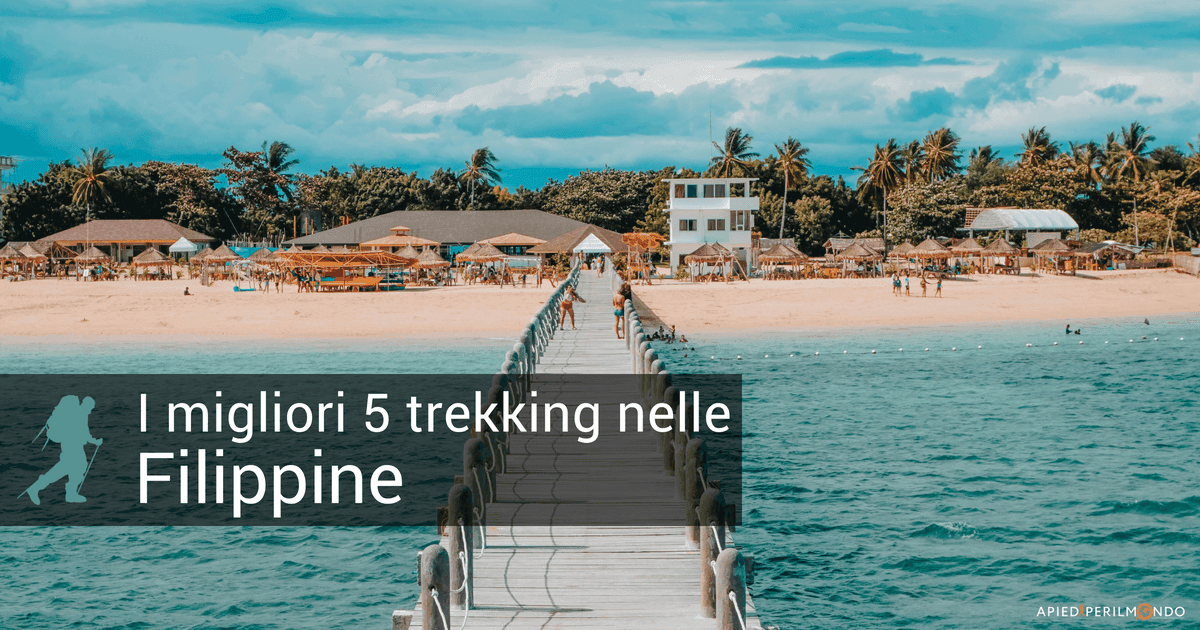
The 5 Best Treks in the Philippines
Planning a Philippines adventure? Combine pristine beaches with unforgettable mountain trekking through volcanic peaks, terraced rice fields, hidden waterfalls, and lush tropical forests. Discover our curated selection of the Philippines' most rewarding walks.

In this article
The Philippines is an archipelago comprising an impressive 7,017 islands and, unsurprisingly, is renowned and cherished primarily for its beaches. The undulating nature of the terrain, however, makes it equally rewarding to explore on foot, and opportunities abound! Among the advantages you can enjoy are certainly the tropical climate and remarkable biodiversity, further emphasised by the archipelago's island nature. Some of the most well-known peaks are actually volcanoes, as is common in this part of the world: the Philippines are indeed part of the so-called "Pacific Ring of Fire". The presence of volcanoes also means natural hot springs: some trekking excursions can be enhanced by rewarding dips in natural hot water sources.
Trekking in the Philippines often allows you to combine time in the interior with coastal breaks, taking full advantage of the ocean and crystal-clear waters—destinations for unforgettable aquatic adventures.
As with many other destinations, it is highly advisable to work with a local agency to organise your walking excursions, whether day trips or multi-day treks. These are often quite remote areas where having a local guide guarantees your safety. Local guides also allow you, as always, to gain a deeper understanding of the territory and interact with the local population—undoubtedly adding real value to your experience. Some (though few) destinations require advance registration, another compelling reason to engage a guide.
The best time of year to visit and trek in the Philippines is between November and April, when rainfall is minimal and inter-island connections are reliable and straightforward. Ideally, choose November–February to enjoy lower temperatures better suited for physical activity. From June to October, travel is not recommended as the rainy season makes everything more challenging.
1. Terraced Rice Fields on Luzon Island, trekking through the heart of a UNESCO World Heritage Site
The most famous terraced rice fields in the Philippines are found in the heart of Luzon Island, the largest and most populous in the entire archipelago. The terraces of Batad and Bangaan have been designated as UNESCO World Heritage Sites, confirming their uniqueness and their place in this list of the 5 best treks in the Philippines.
This terrace system was likely constructed around 1,000 years ago and is still partially in use thanks to an ingenious irrigation system that allows water from higher elevations to channel down and reach the lower terraces. Unfortunately, their use has lost commercial appeal over time: some were damaged by the 1990 earthquake that struck Luzon, while the remainder suffer the effects of El Niño (which periodically brings droughts that push earthworms to the surface). Additionally, the rice varieties cultivated using these traditional methods are no longer economically viable, so many farmers have relocated to areas better suited for cultivating higher-yield crops.
Much like Sapa in Vietnam, trekking among the terraced rice fields essentially means a winding route between villages and viewpoints, without a fixed destination. To best appreciate the experience, you might opt for 3 days/2 nights. Your local guide will decide with you each day the route length based on weather conditions and your interests. Overnight stays are typically in local homestays.
Banaue, the nearest town, is reached by an overnight bus from Manila, which should be booked in advance. While it's possible to visit the terraces on a day trip, given both the journey length from Manila and the area's beauty, it makes far more sense to stay longer and fully appreciate this side of the Philippines, with local people and without rushing.
2. Climbing Mount Kanlaon on Negros Island, one of the Philippines' most active volcanoes
Mount Kanlaon (2,435 m) is located on Negros Island and offers an excellent trekking option in the Philippines on a volcano immersed in tropical forest. The summit is the highest peak in central Philippines. The route to the top takes 2–3 days depending on the trail chosen and is moderately challenging. Important: Mount Kanlaon is one of the Philippines' most active volcanoes, so it's essential to stay informed about trail conditions and volcanic activity; a guide is mandatory for this reason.
Three routes reach the summit. The first is the Wasay Trail (14.5 km) from Mambucal, an area rich in sulfurous hot springs and natural pools. The two days required to reach the main crater—the highest point—involve strenuous trekking that rewards you with breathtaking views and a unique natural environment. The lakes glimpsed along the way are actually extinct craters and are themselves wonders of the area. This route is recommended only for experienced, acclimatised walkers. The descent from the summit typically follows the Guintubdan Trail described below.
The second is the Guintubdan Trail (8 km), less demanding than the Wasay Trail. Here the route is punctuated by particularly striking waterfalls. Given this trail's relative ease, you can opt for an ascent and descent along the same side. In this case, the trek reduces to 2 days.
A third option is the Mananawin Trail (14 km), a moderately difficult route. This also requires 3 days.
You must obtain a permit and hire a guide. Given the route's length and the climb's difficulty, it's advisable to arrange porters to carry camping gear and food.
3. Mount Pulag on Luzon Island
Mount Pulag (2,922 m) is the highest peak on Luzon Island. The route reaching its summit is known as the Ambangeg Trail and requires 4–5 days of walking to complete. More challenging alternatives exist, such as the Akiki Trail and the Vizcaya Trail. Mind the weather: as you approach 3,000 m, temperatures can drop near freezing, so set out well prepared.
Vegetation consists mainly of pine and dwarf bamboo. The local populations, who regard much of the area as sacred territory, belong to the highland ethnic groups of the Kankaney, Kalanguya, and Ibaloi peoples, primarily engaged in agriculture. Luzon is indeed one of the islands contributing most to the country's agricultural production thanks to its climate and geographical features.
The mountain has 3 base camps, two on the Ambangeg Trail and one on the Akiki Trail. In any case, you must bring your own gear and food. The summit can be reached for the traditional sunrise (night ascent) or in the late afternoon for an alternative sunset with unique colours.
For Mount Pulag, no permit is required, but you must register at the Visitor's Centre. Since regulations change frequently, it's wise to inquire beforehand about required documentation to avoid issues or delays on arrival. As always, a local guide is very helpful and will greatly simplify matters. It's also important to note that during peak periods, entrance numbers may be controlled: check with your guide whether booking an entrance time is advisable for popular seasons.
4. Mount Pinatubo and its Turquoise Lake, on Luzon Island
Mount Pinatubo (1,486 m) is another of the Philippines' active volcanoes. Also located on Luzon Island, it offers the chance to explore a geographically distinct area characterised by vast stretches of sand, volcanic ash, and canyons. The main attraction is the Crater Lake, a turquoise lake nestled in a caldera that never fails to leave visitors breathless with its explosion of colours. Swimming in the lake is possible (watch for currents!) or you can take a kayak tour.
The trek can be completed in two days and is not particularly demanding. Alternatively, you can cover part of the distance by 4x4 and limit trekking to a couple of hours to reach the crater. In any case, you'll need to contact a local operator to organise your visit.
It's worth remembering that a landscape so different from the rest of the island resulted from the devastating 1991 eruption that killed over 800 people and is remembered as one of the most powerful eruptions of the 20th century. For this reason, stay informed about the volcano's activity and avoid unnecessary risks.
Mount Pinatubo can be visited from October to April, thus avoiding the wettest and rainiest period. In any case, don't begin the trek if forecasts aren't favourable. From December to February, the Crater Lake is at its best with the blue hues it reflects.
5. Mount Apo on Mindanao Island, trekking in the Philippines with hot springs, waterfalls and volcanic craters
Trekking on Mount Apo (2,954 m) is among the Philippines' finest and is located on Mindanao Island. Mount Apo is simultaneously a volcano and the archipelago's highest peak, characteristics making this destination one of the most captivating.
Several routes lead to the summit. The most popular and least demanding is the Kidapawan Trail and passes through the national park via Kidapawan, completing the trek in 3 days of walking. The trek also passes natural hot springs where you can soak in revitalising waters. Some particularly steep sections are equipped with ropes to aid the ascent. Lake Venado, the country's highest lake, lies 3 hours from the summit, while Mount Apo's ancient crater is just beyond.
For the descent, the so-called Magpet Trail is recommended—simpler and leading to some waterfalls where you can also stop for a swim.
To attempt the ascent of Mount Apo, you must obtain permits and arrange for a guide and porters. The 3-day experience can optionally be extended to 4 or 5 days by adding detours to the main route. In any case, for both permits and on-site organisation, consult with experienced local personnel.
Share
apiediperilmondo by wayure
New articles on walks, trekking and hiking trips. Free, no spam.
Co-fondatore di Apiediperilmondo e Wayure | Camminatore, imprenditore, costruttore
A hundred times the Camino de Santiago. Eight times the Kumano Kodo. Dozens of times the coasts of Portugal, then the Via Francigena, Ireland, England, Normandy: every walk you find here I have done on my own two feet, in every season, alone and with private groups and companies. I do not offer a single step I have not walked.
Profilo e tutti gli articoli di Vincenzo