Camí de Cavalls – Epic Menorca Coastal Trek
Discover the perfect 10-day walking adventure on Menorca's legendary Camí de Cavalls. Pristine beaches, manageable daily stages, and authentic Mediterranean coastline await just a short flight away.

In this article
Open Table of Contents
The Camí de Cavalls is an extraordinarily beautiful route that circles the "quietest of the Balearic Islands," Menorca. Stretching 185km, it follows the entire perimeter of the island, creating a complete loop with Mahón (or Maó in Catalan), the capital, as the ideal starting point. This trek is typically divided into 10 stages, though you can easily adjust the number of stages to suit your own needs and preferences.
Camí de Cavalls: General Information
The Camí de Cavalls is well-marked and has a low to moderate difficulty level. It can be walked year-round, though it's best to avoid the summer months due to intense heat and lack of shade along much of the route. Limited accommodation at stage endpoints means you'll need to plan carefully before departure. You'll need to arrange your daily stages, transport, and accommodation in advance.
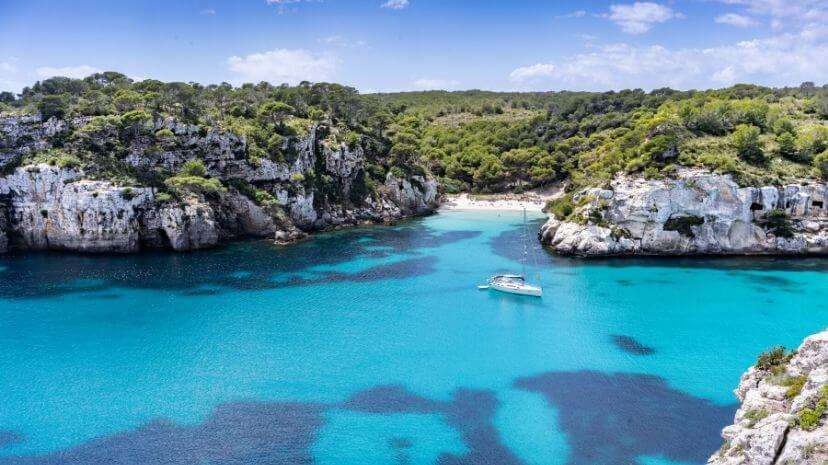
Despite these considerations, the Camí de Cavalls remains one of Europe's most spectacular and well-travelled walking routes. The trail passes alongside stunning landscapes: pristine white-sand coves with crystalline waters, lighthouses, dramatic cliffs, uniquely-shaped rock formations, olive groves, forests, charming whitewashed villages typical of Menorca, towns, archaeological sites, herds of sleek black horses (the distinctive Menorcan breed), and much more!
Testament to Menorca's exceptional natural richness, the island has been a UNESCO Biosphere Reserve since 1993 and is one of the Mediterranean's most important bird habitats. You can spot species such as osprey, cormorant, and red kite.
Difficulty of the Camí de Cavalls
The Camí de Cavalls is a low to moderate difficulty walking route, classified as T/E (Tourist/Hiker) on the hiking difficulty scale. This rating reflects various factors, including elevation gain, absence of water sources along the route, backpack weight, and the importance of thorough pre-trip planning. Let's explore each element:
- Elevation Gain – The Camí de Cavalls has a total elevation gain of 4,650m, which spread over 10 days of walking and 185km of distance, is not physically demanding. You'll benefit from good fitness, though it's not essential. The fitter you are, the easier it becomes, but you don't need to be a mountaineer or train with weekly outings. Regular walking, even near home, plus a few pre-trip hill or mountain hikes, will prepare you adequately.
- Walking Multiple Days Consecutively – Walking for 10 consecutive days is a substantial physical commitment. It's different from tackling a challenging day hike and resting the next day. You must build your endurance and approach each stage with a relaxed philosophy—never rush, respect your natural pace, and take frequent breaks.
- Detailed Planning – As mentioned, the Camí de Cavalls lacks accommodation at the end of every stage, so to ensure shelter each night, meticulous trip planning is essential. Depending on the stage, available public transport, and accommodation availability, you'll need to decide where to sleep and stick to your schedule. This requires knowing your fitness level, your average daily pace, how many breaks you want, and their duration, so you meet any deadlines or appointments.
- Daily Backpack Weight – With good planning, your backpack won't resemble that of a multi-day trek (7-8kg), but rather a day-hike pack of just 3-4kg, containing only what's needed for that day's walk. This positively impacts your trek's success and requires significantly less physical effort.
If you'd prefer not to organize the trek independently or lack time to study the route in detail, we're here to help with complete organization. Check out the organized Camí de Cavalls we offer, and if you have specific needs, contact us for a fully customized proposal. We'll be delighted to help you realize this fantastic trek!
Stages of the Camí de Cavalls
The Camí de Cavalls spans 185km and is typically divided into 10 stages. These are not fixed—you can modify and split them according to your preferences. Some walkers break it into 20 stages of approximately 10km each.
As a loop trail, the walk begins and ends at the same point. For convenience, we start the Camí de Cavalls from Mahón/Maó, not only because it's the island's capital but also because it's well-connected to the nearby airport. Here's our suggested 10-stage division:
- Stage 1 – Mahón to Es Grau
- 10km +290m 3–5 hours
- Stage 2 – Es Grau to Port d'Addaia
- 20km +480m 7–9 hours
- Stage 3 – Port d'Addaia to Fornells
- 13km +300m 5–7 hours
- Stage 4 – Fornells to Binimel Là
- 14km +410m 3–5 hours
- Stage 5 – Binimel Là to Cala Morell
- 22km +1,180m 9–11 hours
- Stage 6 – Cala Morell to Ciutadella
- 19km +310m 5–7 hours
- Stage 7 – Ciutadella to Son Xoriguer
- 17km +150m 4–6 hours
- Stage 8 – Son Xoriguer to Sant Tomàs
- 26km +750m 8–10 hours
- Stage 9 – Sant Tomàs to Binissafúller
- 25km +530m 8–10 hours
- Stage 10 – Binissafúller to Mahón
- 21km +250m 6–8 hours
Trail Markings on the Camí de Cavalls
The Camí de Cavalls features excellent signage throughout its entire length, of high quality and durability. Completed in 2010 and located within a protected area, the markers are recent and constructed from resistant, eco-friendly materials.
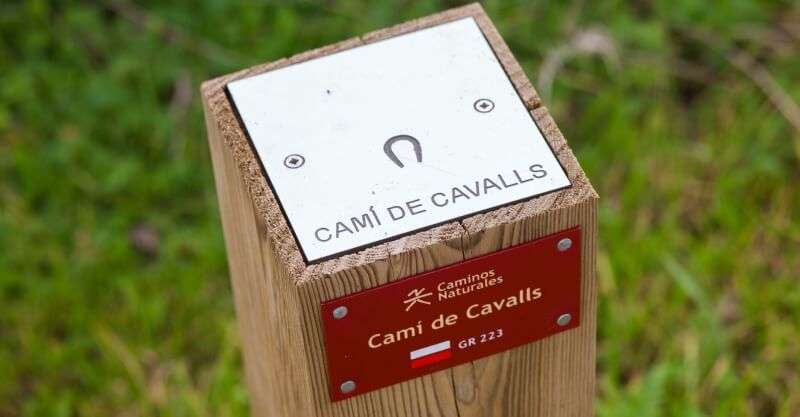
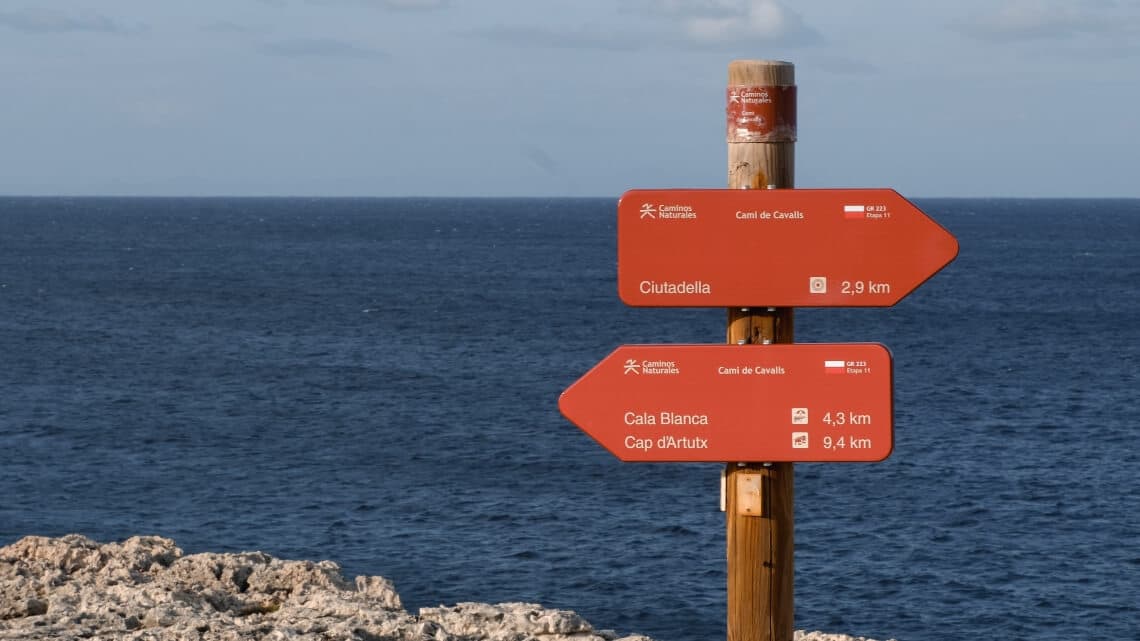
The red-painted signs bear the Camí de Cavalls symbol, the "GR223" designation, and the logo of "Caminos naturales"—Spain's network of hiking, cycling, and equestrian trails. Two types of signage mark the route:
- Wooden Posts – Approximately one metre tall, these strategically-placed posts are highly visible to walkers, similar to those found on the Rota Vicentina, another stunning coastal trek. Each features a red tag on the front and a white panel on top bearing the Camí de Cavalls name.
- Metal Arrows – Mounted on two-metre poles, these fully-red signs feature white lettering. They display nearby locations and the distances required to reach them.
When to Walk the Camí de Cavalls
Menorca, a Balearic island in the heart of the Mediterranean, receives just 600mm of annual rainfall, with mild temperatures year-round—never dropping below 5°C in winter. Certainly, summers are very hot, with temperatures around 30°C, perfect for a beach holiday but less ideal for hiking, especially given the lack of shade along the route.
Excluding July and August, the Camí de Cavalls is walkable throughout the rest of the year. Winters are mild, with rainfall never exceeding 80mm monthly. The main challenge may be limited accommodation, with many facilities closed in low season.
Spring and Autumn are the ideal seasons for the Camí de Cavalls, though autumn precipitation reaches 80–100mm monthly, compared to 20–40mm in April and May. Temperatures are similar for both seasons, around 15–20°C, ideal for any walker! Regardless of these important and valid considerations, Spring always has the edge with its flowers, fragrances, and that special quality of light that makes everything feel magical!
Share
apiediperilmondo by wayure
New articles on walks, trekking and hiking trips. Free, no spam.
Co-fondatrice, Apiediperilmondo
I've been organising walks since I discovered that walking slow is the fastest way to know a place. I take care of every logistical detail so you can focus only on the steps ahead.
Profilo e tutti gli articoli di DeborahDiscover our itineraries
in Spain.
Cami de Cavalls - Menorca
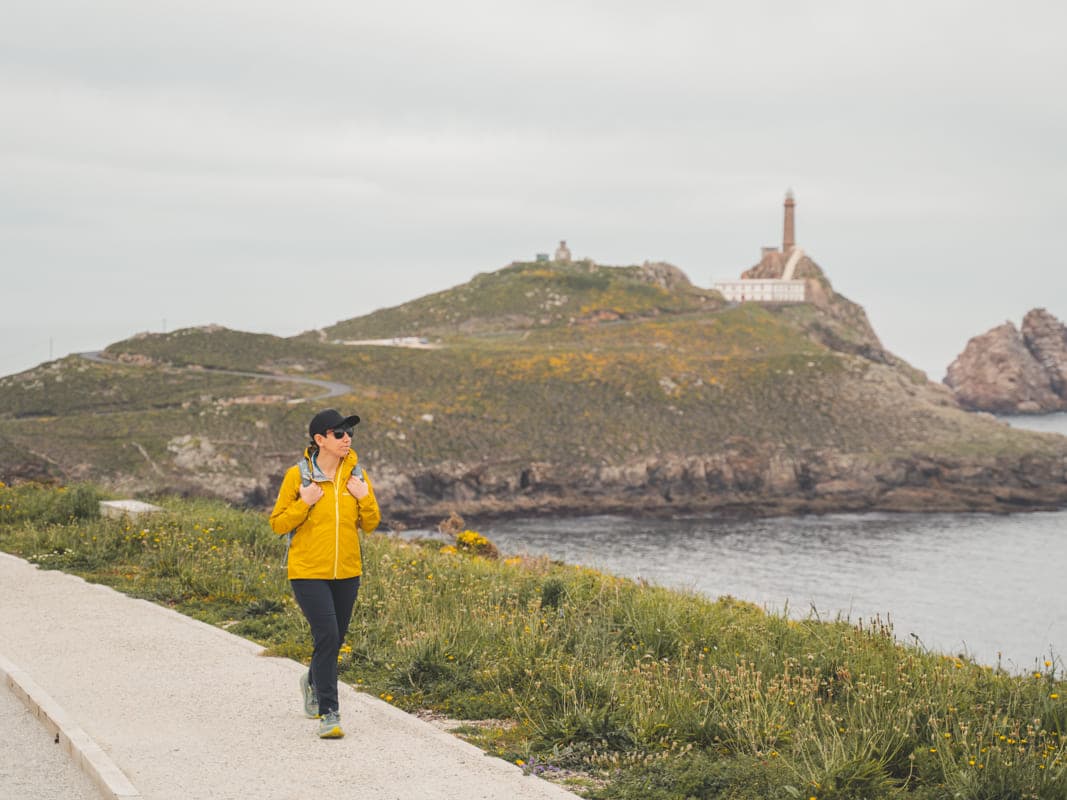
Camino de los Faros in Galicia from Malpica to Finisterre
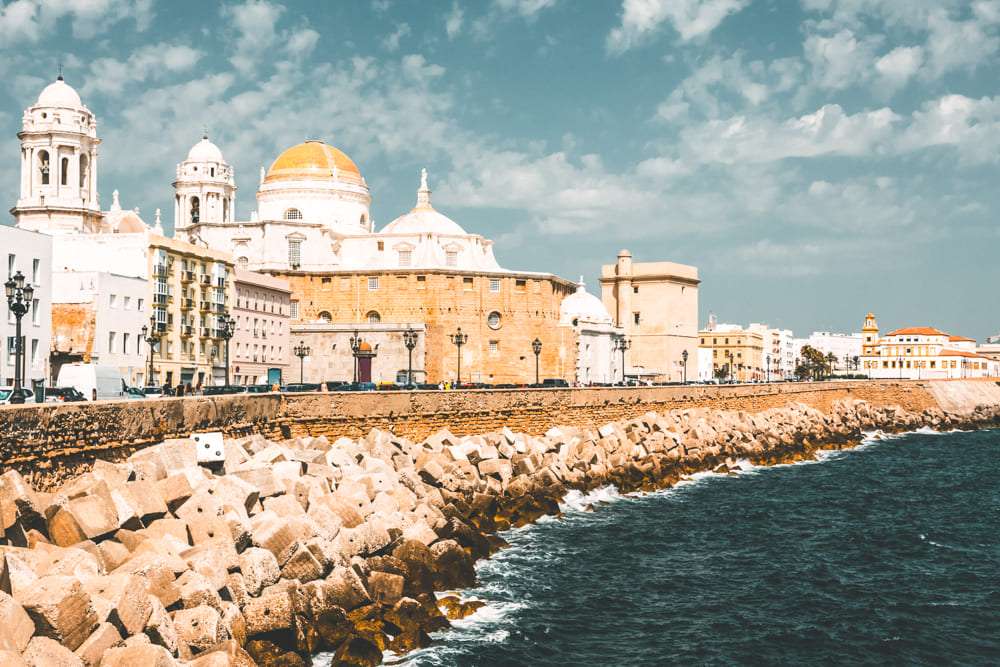
Via Augusta from Cadiz to Seville
Want a tailor-made itinerary?
Plan your trip