Walking Holidays in Malta and Gozo
Self-guided walking holidays across Malta and Gozo, where the walking is the holiday. What to expect, when to go, and the Gozo Coastal Walk.

In this article
Search for walking holidays in Malta and Gozo and you get a handful of coach tours with a token stroll bolted on. That is not what we do. We build self-guided walking trips across these islands, where the walking is the holiday and everything around it is arranged so you never have to think about logistics. This page is the honest version: what the terrain is really like, when to come, how hard it is, and who these islands suit.
An honest note first. Malta and Gozo are small, sun-baked and steeped in history, and they reward walkers who want short-to-moderate days with big rewards rather than long alpine slogs. If you picture a Mediterranean coastline that changes character every kilometre, you are close to the truth.
What walking in Malta and Gozo is actually like
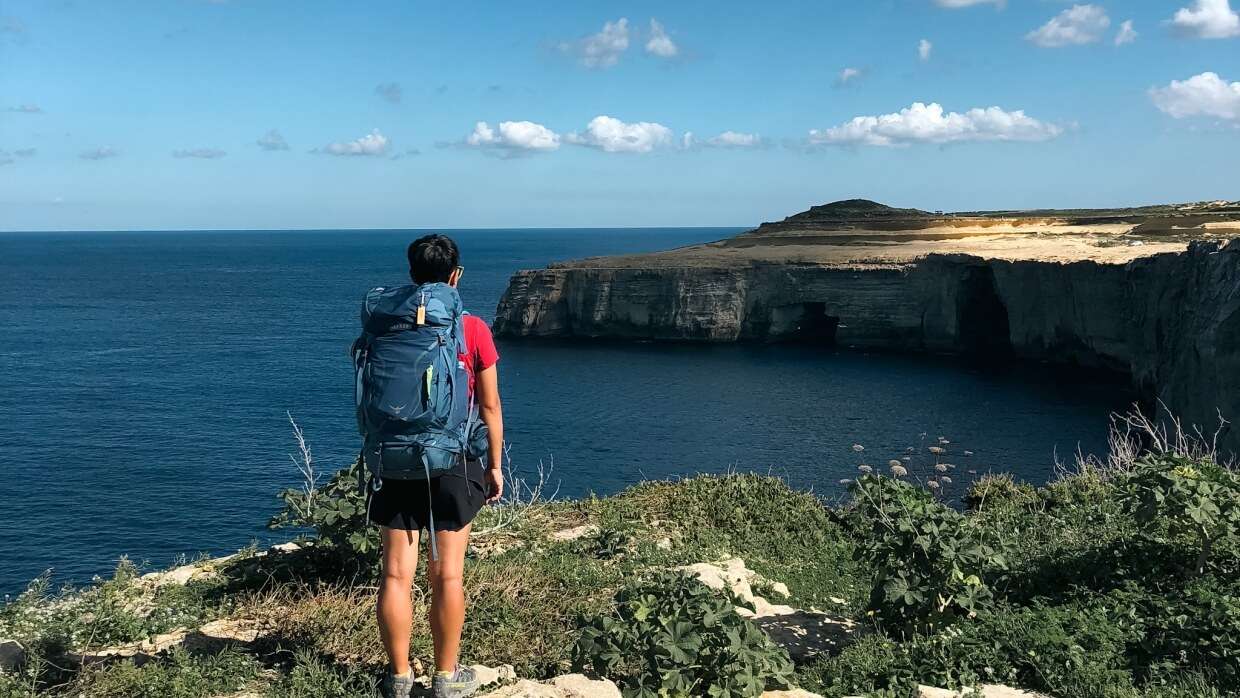
Forget forests and switchbacks. Here you walk on limestone cliffs, along old field walls, past salt pans cut into the rock, through tiny villages built around an oversized baroque church. The coast is the star. Paths trace the edge of the sea for hours, with the water turning from turquoise to deep blue as the light shifts. Inland you cross terraced fields, garigue scrub scented with wild thyme, and the occasional Neolithic temple older than the pyramids.
The two islands feel different. Malta is busier, its walks threading between towns, watchtowers and the honey-coloured bastions of Valletta. Gozo is quieter, greener in spring, slower in every sense. Most people who come for the walking end up preferring Gozo, and we understand why.
The Gozo Coastal Walk
The route we return to again and again is the Gozo Coastal Walk, a loop that traces almost the entire shoreline of the island over several days. You walk clifftop paths above the Inland Sea, drop into hidden bays, pass the site of the old Azure Window, and climb gently to the citadel of Victoria in the centre. Each day ends in a village where you sleep, eat and start again the next morning in a new direction.
It works as a walking holiday because the distances are humane. Days run roughly ten to fifteen kilometres, enough to feel you have travelled, short enough to leave the afternoon for a swim or a long lunch. Nothing about it is a test of endurance. It is a test of how slowly you are willing to go.
When to go
Spring is the answer for most people. From late February to May the islands are green, the wildflowers are out, and the temperature sits in the range where walking all day is a pleasure rather than a battle with the sun. Autumn, from late September to November, is the other good window: the sea is still warm enough to swim, and the summer crowds have gone.
We do not recommend July and August for walking. The heat on exposed limestone is relentless and there is almost no shade on the coast. If summer is your only option, days have to start at dawn and finish by late morning, which changes the character of the trip.
How difficult is it
Moderate, and honestly closer to easy than hard. The paths are mostly clear, the climbs are short, and no single day asks more of you than a good level of general fitness can handle. What catches people out is the ground itself: bare limestone can be uneven and, after rain, slippery. Decent walking shoes with grip matter more here than any amount of training.
Who it suits
Malta and Gozo suit walkers who want scenery, sea and culture in equal measure, and who would rather do six comfortable days than three brutal ones. They suit couples, friends travelling together, and solo walkers who like the reassurance of a route that is organised but the freedom of walking it alone. They suit anyone who has done a longer pilgrimage and wants something gentler next. They do not suit people chasing altitude or wilderness. There is no wilderness here. There is history at every turn instead.
How self-guided walking works
Self-guided means you walk on your own schedule, with no group and no guide setting the pace, but nothing left to chance. We plan the route, book every night's accommodation in the right village, move your luggage from one stop to the next so you carry only a daypack, and hand you clear day-by-day notes and maps on your phone. You wake up, walk, and arrive to find your bag already there. If anything goes wrong, there is a number to call. That is the whole idea: the structure of an organised trip with the solitude of walking by yourself.
Is Gozo big enough for a whole walking holiday?
Yes, and this is the question we hear most. Gozo is small on a map but its coastline is long and folded, and walking it slowly reveals far more than driving ever could. Four to six days on foot is enough to circle the island, see the parts no day-tripper reaches, and still have time to stop. Small does not mean short. It means concentrated.
If any of this sounds like the pace you are after, have a look at the Gozo Coastal Walk or browse all our walking routes to see how a trip like this comes together.
Share
apiediperilmondo by wayure
New articles on walks, trekking and hiking trips. Free, no spam.
Co-fondatore di Apiediperilmondo e Wayure | Camminatore, imprenditore, costruttore
A hundred times the Camino de Santiago. Eight times the Kumano Kodo. Dozens of times the coasts of Portugal, then the Via Francigena, Ireland, England, Normandy: every walk you find here I have done on my own two feet, in every season, alone and with private groups and companies. I do not offer a single step I have not walked.
Profilo e tutti gli articoli di Vincenzo