Walking in Portugal: trails, coast and the Camino
Portugal has two walking souls: the historic Caminos heading to Santiago, and the wild trails of the southwest coast. We have walked them all. Here is how to choose.

In this article
Yes, people walk in Portugal, and not only towards Santiago. The country has two walking souls that rarely meet: on one side the historic Caminos climbing north into Galicia, on the other the wild trails of the southwest coast, where the ocean stays with you for whole days. We have walked both, and the difference is sharp. In this guide I explain what to expect from each, when to go and who they are for, with links to our real trip pages.
An honest note first: there is no single best Portugal on foot. There is the right one for you. If you want villages, churches and the goal of Santiago, you choose the Portuguese Camino. If you want cliffs, empty beaches and silence, you choose the Alentejo coast. Below you will find both, with the real numbers taken from our itineraries.
The two souls of walking in Portugal
The Portuguese Camino is the second most walked route to Santiago de Compostela after the French Way. It starts in Lisbon or, more often, in Porto, and heads north across the Minho and then into Galicia. It is a Camino of community, of yellow arrows, of towns that follow one another a few hours apart. The Rota Vicentina and its coastal stretch, the Fisherman's Trail, are the opposite: born as paths for fishermen and farmers in the Southwest Alentejo Natural Park, they stay almost always within sight of the ocean.
The Portuguese Camino to Santiago
If this is your first thought about Portugal on foot, you are almost certainly thinking of this. The Portuguese Camino has a structure that makes it suitable for anyone: regular stages, a gentle elevation profile compared with other Caminos, and the freedom to choose its length. You can walk a week on the final hundred kilometres, or take three weeks and start from Porto. We have gathered every variant in the Portuguese Camino hub and in the one dedicated to starting from Porto.
The best loved starting point is Tui, the last Spanish town before the border, from which exactly the hundred kilometres needed to earn the Compostela on foot remain. Those who want to start even closer choose Vigo. These are the options for anyone with a week who wants to reach Santiago without rushing.
Coast or interior: how the Portuguese Camino changes
From Porto northwards the Camino splits in two. The Coastal variant follows the Atlantic on wooden boardwalks, between beaches and fishing villages, and for many it is the most beautiful. The Interior variant stays inland, among Vinho Verde vineyards and quiet towns, and is the most faithful to the historic route. If you want the coast but starting already in Galicia, there is the variant from A Guarda. There is no wrong choice: the coast gives you views, the interior gives you stillness.
The Rota Vicentina and the Fisherman's Trail
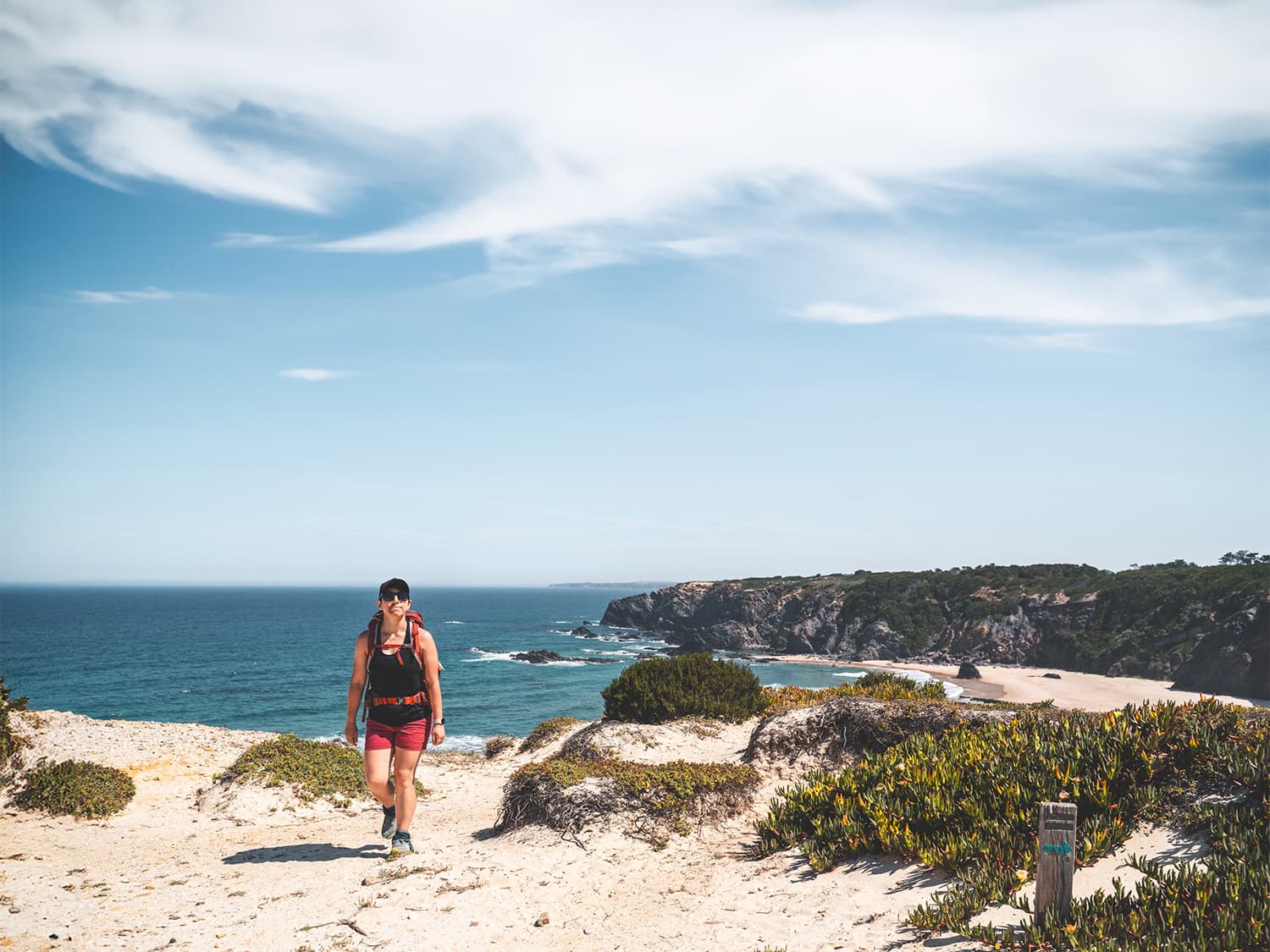
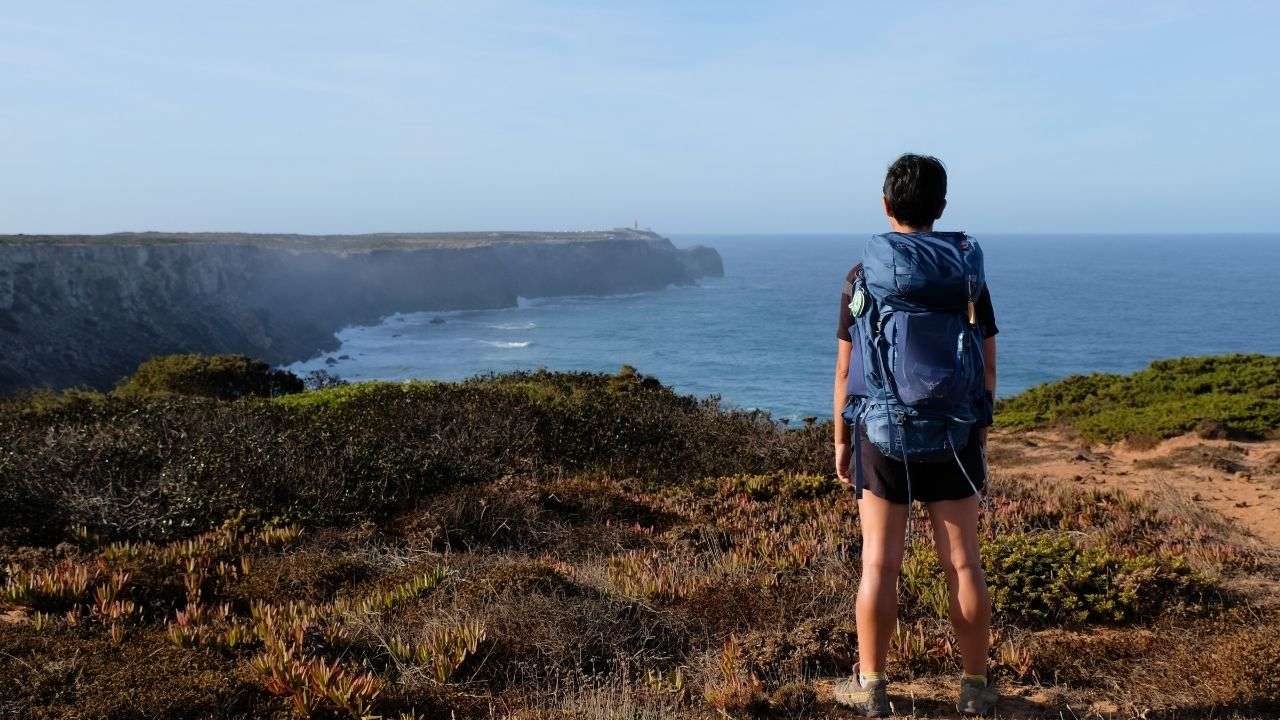
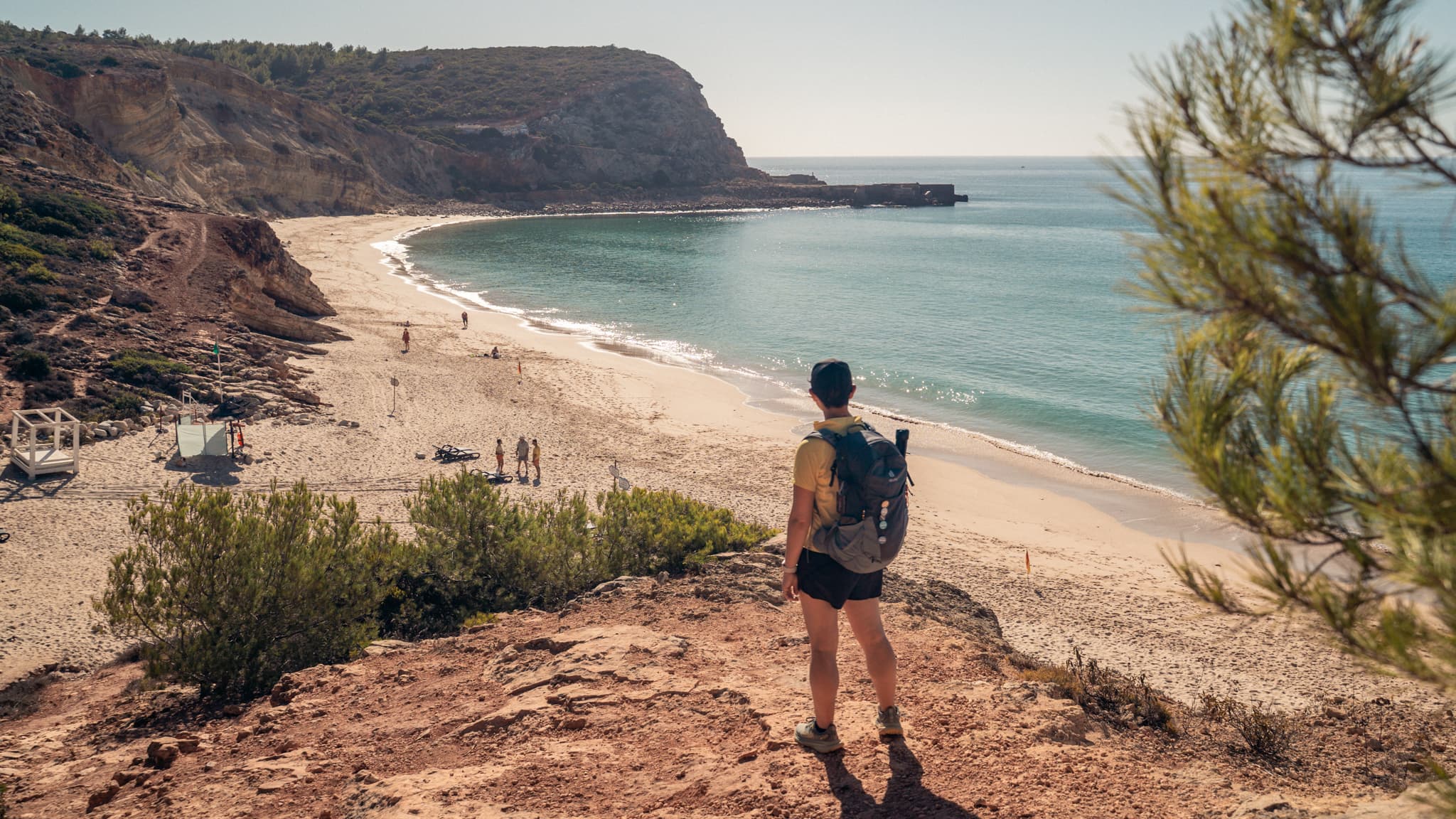
Here everything changes. The Rota Vicentina leads to no cathedral: it leads back to yourself. The Fisherman's Trail is its heart, a path fishermen once used to reach the rocks, today one of the most spectacular coastal treks in Europe. You walk on sand, on cliffs, with the ocean wind always on you. It is harder than the Camino: no asphalt, but dunes and soft sand that tire the legs. In return, beaches where you meet no one for hours.
The routes at a glance
| Route | Area | Km | Days |
|---|---|---|---|
| Fisherman's Trail | Alentejo and Algarve coast | 65 | 6 |
| Portuguese from Vigo | Galicia | 102 | 8 |
| Portuguese from Tui | Galicia, border | 115 | 8 |
| Coastal from A Guarda | Galicia and Portugal coast | 157 | 11 |
| Rota Vicentina | Southwest Alentejo | 206 | 13 |
| Portuguese Interior | Inland from Porto | 240 | 13 |
| Coastal from Porto | Northern Portugal coast | 280 | 15 |
When to go
Portugal walks well for many months of the year, but the seasons are not the same for its two worlds. For the Portuguese Camino the best months are April to June and September to October: mild temperatures, long days, less rain than northern Galicia sees in winter. July and August are possible, but the towns towards Santiago get crowded. For the Rota Vicentina and the Fisherman's Trail the opposite is true: spring is glorious for the flowering on the cliffs, autumn is warm, while summer brings strong wind and direct sun with no shade. March, April, May, September and October are the golden window on the coast.
Who it is for and how self-guided works
Walking self-guided means the route is yours, but the logistics are not. You walk light, with a small day pack; we handle the rest. We book the accommodation stage by stage, move your luggage from one hotel to the next, and give you the GPS tracks and walking notes on your phone. There is no group to follow, no guide dictating the pace: you leave when you want and stop where you want. It is the right formula for anyone who wants the freedom of walking without the weight of organising it.
It works for those walking alone, as a couple or with friends, and it does not require athlete training. On the Portuguese Camino stages run around fifteen to twenty kilometres a day, within reach of anyone who moves a little. The Fisherman's Trail asks a bit more of the legs because of the sand, but there too the distances stay manageable.
Can you walk in Portugal without experience?
Yes. The Portuguese Camino is one of the best ways to start multi-day walking: clear waymarking, short stages, frequent lodgings. With the self-guided formula you do not need to read a map or plan anything, you just put one foot in front of the other.
Portuguese Camino or Rota Vicentina, which is better?
It depends on what you are after. The Portuguese Camino if you want villages, history and the goal of Santiago. The Rota Vicentina if you want pure nature, ocean and solitude. The first is gentler, the second wilder.
How many days do you need to walk in Portugal?
Six days are enough to taste the Fisherman's Trail, or a week for the final hundred kilometres to Santiago from Tui. If you want the full experience from Porto, plan for two to three weeks.
Do you need to be fit?
You need a little habit of walking, no more. If you can manage a two or three hour walk without trouble, you are ready for most of our itineraries. The rest we build around your own pace.
Share
apiediperilmondo by wayure
New articles on walks, trekking and hiking trips. Free, no spam.
Co-fondatore di Apiediperilmondo e Wayure | Camminatore, imprenditore, costruttore
A hundred times the Camino de Santiago. Eight times the Kumano Kodo. Dozens of times the coasts of Portugal, then the Via Francigena, Ireland, England, Normandy: every walk you find here I have done on my own two feet, in every season, alone and with private groups and companies. I do not offer a single step I have not walked.
Profilo e tutti gli articoli di Vincenzo