Trekking Through America's Greatest Parks
Experience the ultimate adventure by combining an iconic American parks tour with multi-day trekking expeditions. Discover breathtaking landscapes, pristine wilderness, and the profound connection that comes from exploring on foot.

In this article
Table of Contents
Who hasn't dreamed of a road trip across the United States, perhaps in a campervan or a Mustang, and visiting its magnificent National Parks? And if we add trekking experiences to that mix, how truly unforgettable would your journey be?
Trekking in USA National Parks: What We Cover in This Article
There are countless articles and guides written about USA National Parks, particularly those in California. Millions of people visit them each year—solo or in organised groups—often rushing through and seeing them only superficially.
In this series of articles, of which this is the overview, I'm speaking to passionate walkers and pilgrims—those who love discovering places at a slow pace and aren't satisfied with visiting a Park like Yosemite in just an afternoon. I understand that typical Park tour itineraries are tight, designed to see as much as possible in the shortest time. Well, I want to convince you to do the exact opposite! If, like me, you love walking through wild nature, crossing it on foot, touching rock walls or feeling waterfall spray with your own hands, and can't settle for a photo and move on, then you're in the right place!
In this article, I'll address trekking in American Parks from a broad perspective, offering you an overview of all USA Parks—did you know there are 62 of them?!—along with hiking rules, safety guidelines, information about wildlife, and how to approach encounters responsibly. The articles that follow will focus on individual Parks and their most beautiful trails.
History of America's National Parks
Today, the United States National Parks stand as a global model for how tourism can thrive while prioritising the conservation and preservation of authentic, wild, and unspoiled nature. Of course, challenges remain—particularly regarding sustainability—but thanks to awareness campaigns and growing visitor understanding of how to minimise environmental impact, significant progress is being made.
However, this hasn't always been the case. Before the National Parks were established, entrepreneurs had begun dividing up Yosemite Valley land and planning its exploitation, both for tourism and resource extraction. Fortunately, a group of naturalists, writers, and artists—including the renowned landscape architect Frederick Law Olmsted—united against these business interests and waged a fierce battle through the press and in politics. They successfully convinced then-President Lincoln of the necessity to protect these lands from speculation. Thus a bill was passed placing these lands under state control. This was in 1864.
However, we had to wait until 1872 to see the world's first National Park, when President Ulysses S. Grant established Yellowstone National Park. From this point forward, more and more National Parks were created with increasing legal protections to ensure environmental respect and, most importantly, enforce hunting bans. The National Park Service was established (1916) as a national coordinating body for the parks. The Ranger corps was born, parks became major tourist attractions, and under President Roosevelt (1930s), significant improvements were made to roads and accommodations.
America's National Parks thus began to become what they are today! In terms of numbers, consider that in 2019 alone, visitors exceeded 300 million! Here are the 10 most visited National Parks:
- Great Smoky Mountains National Park
- Grand Canyon National Park
- Rocky Mountain National Park
- Zion National Park
- Yosemite National Park
- Yellowstone National Park
- Acadia National Park
- Grand Teton National Park
- Olympic National Park
- Glacier National Park
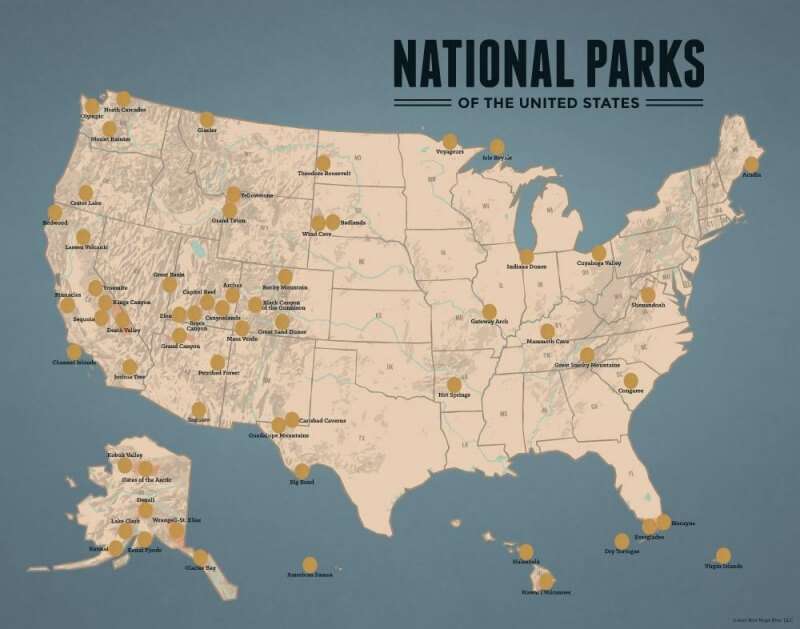
62 USA National Parks
There are currently 62 National Parks in the United States.
Here's a list of USA National Parks organised by state.
- Denali National Park (Alaska)
- Gates of the Arctic NP and Kobuk Valley NP (Alaska)
- Glacier Bay National Park (Alaska)
- Katmai National Park (Alaska)
- Kenai Fjords National Park (Alaska)
- Kobuk Valley National Park (Alaska)
- Lake Clark National Park & Preserve (Alaska)
- Wrangell-St. Elias National Park (Alaska)
- Grand Canyon National Park (Arizona)
- Petrified Forest National Park (Arizona)
- Saguaro National Park (Arizona)
- Hot Springs National Park (Arkansas)
- Channel Islands National Park (California)
- Death Valley National Park (California)
- Joshua Tree National Park (California)
- Kings Canyon National Park (California)
- Lassen Volcanic National Park (California)
- Pinnacles National Park (California)
- Redwood National Park (California)
- Sequoia National Park (California)
- Yosemite National Park (California)
- Black Canyon of the Gunnison National Park (Colorado)
- Rocky Mountain National Park (Colorado)
- Great Sand Dunes National Park (Colorado)
- Mesa Verde National Park (Colorado)
- Biscayne National Park (Florida)
- Dry Tortugas National Park (Florida)
- Everglades National Park (Florida)
- Haleakalā National Park (Hawaii)
- Hawai'i Volcanoes National Park (Hawaii)
- Indiana Dunes National Park (Indiana)
- Mammoth Cave National Park (Kentucky)
- Acadia National Park (Maine)
- Isle Royale National Park (Michigan)
- Voyageurs National Park (Minnesota)
- Gateway Arch National Park (Missouri)
- Glacier National Park (Montana)
- Great Basin National Park (Nevada)
- Carlsbad Caverns National Park (New Mexico)
- White Sands National Park (New Mexico)
- Great Smoky Mountains National Park (North Carolina – Tennessee)
- Crater Lake National Park (Oregon)
- Cuyahoga Valley National Park (Ohio)
- National Park of American Samoa (American Samoa)
- Congaree National Park (South Carolina)
- Badlands National Park (South Dakota)
- Wind Cave National Park (South Dakota)
- Theodore Roosevelt National Park (North Dakota)
- Big Bend National Park (Texas)
- Guadalupe Mountains National Park (Texas)
- Arches National Park (Utah)
- Bryce Canyon National Park (Utah)
- Canyonlands National Park (Utah)
- Capitol Reef National Park (Utah)
- Zion National Park (Utah)
- Virgin Islands National Park (U.S. Virgin Islands)
- Shenandoah National Park (Virginia)
- Mount Rainier National Park (Washington)
- North Cascades National Park (Washington)
- Olympic National Park (Washington)
- Grand Teton National Park (Wyoming)
- Yellowstone National Park (Wyoming)
In addition to these, it's important to mention Antelope Canyon, in Arizona, which is absolutely a must-see!!
Trekking in American Parks: Rules and Safety
Trekking in American National Parks is a joy for every lover of nature and walking. The vast spaces, breathtaking landscapes, contact—at a safe distance, of course!—with the wildlife that inhabits these lands, and the rediscovery of a more authentic self all contribute to making this journey one of the most beautiful experiences of our lives!
However, enthusiasm must go hand-in-hand with respect for rules and specific guidelines about how to behave in certain situations, often very different from our everyday world. True, you're walking on well-trodden trails and established routes, perhaps not alone and accompanied by other hikers, but it's necessary to always stay alert and be fully "present" with all your senses.
It's easy to get distracted, especially when surrounded by such beauty, and it can happen that you lose the trail, stumble, or lose contact with your hiking companions. And how do you reach them if your phone has no signal?
Another risk is misjudging time and being caught in darkness on the way back. Since this situation happens often, some trails have a marked point of no return: if you reach it past a certain time, you must turn back immediately and not attempt to reach your destination, as you won't make it back in daylight. And believe me, hiking in the dark on trails you don't know, especially mountain trails, is absolutely not recommended!
To reduce accidents as much as possible and make hikers more aware of the rules to follow, the National Park Service has compiled a short list of dos and don'ts for a HIKE SAFE experience. I've included it here in the original language, with the translation below.
Share
apiediperilmondo by wayure
New articles on walks, trekking and hiking trips. Free, no spam.
Co-fondatrice, Apiediperilmondo
I've been organising walks since I discovered that walking slow is the fastest way to know a place. I take care of every logistical detail so you can focus only on the steps ahead.
Profilo e tutti gli articoli di DeborahTurn this inspiration into a real journey.
Tell us about your dream walk: we will build the itinerary together.