The Wool and Silk Road
Walk 130km through the heart of the Tuscan-Emilian Apennines on this historic trade route connecting Bologna to Prato, where ancient pathways reveal stories of medieval commerce and stunning mountain landscapes.

In this article
Open Table of Contents
The Via della Lana e della Seta is a 130 km trek connecting Bologna and Prato, two iconic textile cities in Emilia Romagna and Tuscany respectively. The route winds through the rolling hills of the Tosco-Emiliano Apennines and can be completed in 6 days. Like the Via degli Dei from Bologna to Florence, this trail is a nature-focused hiking experience, perfect for those seeking an immersive week-long journey through Italy's countryside.
Via della Lana e della Seta: Essential Information
The Via della Lana e della Seta begins in Bologna, following the Reno canal before climbing the Apennine spine along the valleys of rivers such as the Setta, eventually descending to Prato along the Bisenzio valley. The route traverses national parks, nature reserves and protected areas where you may encounter wild deer, roe deer, stags and wild boar. Numerous medieval villages and historically significant towns dot the daily stages, and discovering these settlements and meeting their inhabitants is a defining feature of this walk.
Human settlement in these territories dates back to the Bronze Age. Etruscans, Romans, Byzantines and Lombards all established communities here, testament to the region's natural abundance. In more recent history, these lands witnessed partisan resistance during World War II, with many monuments along the route commemorating these pivotal events.
In recent decades, unfortunately, many small villages have experienced depopulation. Routes like the Via della Lana e della Seta aim to revitalise these communities and contribute to local economies, whilst enabling travellers to discover the natural treasures of Italy.
Bologna and Prato share a common historical legacy: textile manufacturing and the working of wool and silk. Water is the common thread binding this journey together. Over centuries, strategically built infrastructure—including the Chiusa on the Reno river and the Cavalciotto (dating from the 12th century)—channelled water into these cities, powering countless artisan workshops, mills, fulling mills for wool processing, and looms.
Difficulty Rating of the Via della Lana e della Seta
The Via della Lana e della Seta is a medium-to-high difficulty trek, rated E (Escursionistico) according to the hiking difficulty scale. Due to significant elevation changes and the remote nature of sections, good physical conditioning and mountain hiking experience are essential. Multi-day trekking with a loaded backpack demands considerable physical and mental stamina. Let's explore these challenge factors in detail.
- Substantial elevation gain – The primary difficulty of the Via della Lana e della Seta comes from its elevation changes. Many assume the Apennines, being lower than the Alps, feature gentler ascents and descents. Not so. The route totals nearly 9,000m of cumulative elevation, split evenly between climbs and descents. Spread across 6 trekking days, this amounts to approximately 1,500m daily elevation gain.
- Multi-day trekking challenge – Confronting such elevation over 6 consecutive days represents considerable physical and mental exertion. Remember, greater elevation means slower progress and longer walking hours. Proper training makes a significant difference, allowing you to tackle this route with greater ease and confidence.
- Backpack weight (7-8kg) – If your mountain experience involves day hikes with a light daypack that empties at lunch, think carefully. Multi-day trekking with these elevation gains while carrying 7-8kg demands solid physical conditioning. Strengthen yourself by carrying a weighted pack during day hikes beforehand—roughly equivalent to your trekking load. Additionally, gear selection matters. A lighter pack eases the overall difficulty. For equipment advice, see our dedicated article.
Daily Stages of the Via della Lana e della Seta
The Via della Lana e della Seta comprises 6 main stages, though additional small villages along the route offer opportunities to break stages into shorter sections, allowing you to extend or reduce your trekking duration. All principal towns have railway stations, enabling you to complete the entire route in one go or tackle it across multiple weekends.
- Stage 1 – Bologna to Sasso Marconi
- 20 km +225m -160m
- Stage 2 – Sasso Marconi to Grizzana Morandi
- 27 km +1,350m -920m
- Stage 3 – Grizzana Morandi to Castiglione dei Pepoli
- 22 km +910m -790m
- Stage 4 – Castiglione dei Pepoli to San Quirico di Vernio
- 20 km +565m -890m
- Stage 5 – San Quirico di Vernio to Vaiano
- 21 km +660m -720m
- Stage 6 – Vaiano to Prato
- 22 km +630m -915m
Trail Markers on the Via della Lana e della Seta
The Via della Lana e della Seta follows a carefully curated network of CAI mountain paths crisscrossing the Apennines. Waymarking is excellent—both clear and comprehensive. Getting lost requires genuine inattention; miss a few markers and you may stray off course. GPS tracks and paper guidebooks provide valuable backup navigation tools.
Two types of waymarking guide you:
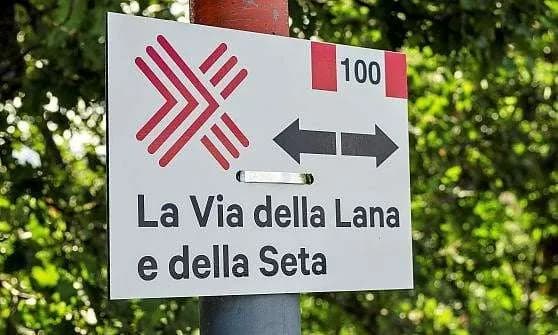
- Vertical signage with direction markers bearing the Via della Lana e della Seta logo;
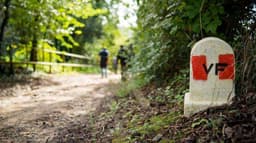
- Horizontal markings—red and white blazes with "VLS" (the trek's acronym) painted on rocks, trees, walls and other surfaces.
Best Time to Walk the Via della Lana e della Seta
The Via della Lana e della Seta crosses mountainous, forested terrain deep in the Tosco-Emiliano Apennines, using primarily footpaths and unpaved tracks. Considering ground conditions, latitude, altitude and weather patterns, late spring through early autumn offers optimal trekking conditions.
From November to April, heavy rainfall and forested terrain with abundant water sources create muddy, challenging paths. Low-cut hiking shoes are inadvisable. Invest instead in high-ankle, waterproof trekking boots.
Temperatures, though cool, pose no hardship with appropriate layered clothing.
From May to October, lower precipitation and warmer temperatures greatly favour trekkers. Don't worry about heat—forest canopy provides welcome shade and relief from direct sun.
Accommodation on the Via della Lana e della Seta
The Via della Lana e della Seta runs 130km through the Tosco-Emiliano Apennines from Bologna to Prato (and vice versa). Though these areas may appear remote, the trail passes through numerous villages, all offering overnight options. Beyond Bologna and Prato—which have full hospitality services—accommodation variety is modest and requires some flexibility.
Unlike the Camino de Santiago or the Via Francigena, no dedicated pilgrim hostels operate on this route. However, you'll find modest family-run hotels and B&Bs offering comfortable rooms and modern amenities. Many partner properties offer rates around €20-25 per person per night.
Trek Credential (Credenziale) for the Via della Lana e della Seta
Like most Italian walking routes, the Via della Lana e della Seta offers a credential (pilgrim passport). This accordion-folded booklet records your personal details and collects stamps from towns visited along your journey.
With stamps from a minimum of 6 localities, you can claim a trek keepsake—such as a keyring or wristband—from the tourism offices in Bologna, Sasso Marconi or Prato.
What to Eat on the Via della Lana e della Seta
Ca
Share
apiediperilmondo by wayure
New articles on walks, trekking and hiking trips. Free, no spam.
Redazione
La redazione di Apiediperilmondo. Guide, itinerari e storie nate camminando: consigli pratici, cammini in Italia e nel mondo, letture e spunti per chi viaggia a piedi.
Profilo e tutti gli articoli di ApiediperilmondoDiscover our itineraries
in Italy.
Via degli Dei in 5 stages
Via Francigena from Lucca to Siena
Via del Sale from Varzi to Portofino
Want a tailor-made itinerary?
Plan your trip