Climbing Mount Kinabalu in Malaysian Borneo
Reach the summit of Malaysia's highest peak at 4,095m on this unforgettable trek. Experience the raw beauty of Borneo's wilderness without technical climbing gear—just your feet, determination, and the mountain's magic.
A Piedi Per Il Mondo

In this article
Climbing Mount Kinabalu in Malaysian Borneo
Climbing Mount Kinabalu is an unforgettable experience that allows you to reach the summit of Malaysia's highest mountain at 4,095 metres on foot and without specialised technical equipment. Stunning natural landscapes and breathtaking panoramas worthy of true Adventure with a capital A!
Mount Kinabalu (Gunung Kinabalu), standing at 4,095 metres, is Malaysia's highest mountain. Located in the Sabah region, which together with Sarawak comprises Malaysian Borneo, the mountain sits within one of the world's richest and most threatened ecosystems. Borneo itself is a guarantee of natural wealth: pristine beaches, vast river systems, tropical rainforests, and an incredible array of wildlife.
Ascending Mount Kinabalu means undertaking a continuous climb, though never excessively steep. Your efforts will be rewarded with an equatorial sunrise of extraordinary colours, with views stretching to the Philippines on exceptionally clear days.
The experience is well-organised and integrates seamlessly into longer journeys, as the location is easily accessible (just over 2 hours from Kota Kinabalu, the main hub in Sabah) and the trek is completed in just one and a half days. This allows you to move on to your next destination by mid-afternoon on day two.
Essential Information About Mount Kinabalu, Malaysia
Mount Kinabalu was first climbed by Hugh Low in 1851 (though he didn't reach the summit); the highest peak was finally reached in 1888 and named Low's Peak in his honour. The Mount Kinabalu National Park was established in 1964 and became a UNESCO World Heritage Site in 2000.
The mountain's slopes are characterised by a tropical montane climate (at 1,500 metres, rainfall averages 2,700 mm annually) and constitute one of the world's most important ecosystems, with 6,000 plant species, 326 bird species, and over 100 identified mammal species. This climate is ideal for the Rafflesia, the world's largest flower (exceeding 90 cm in diameter). More common flowers include orchids. Many species are endemic: of the 600 fern species, at least 50 exist only here. Another distinctive plant is the carnivorous Nepenthes Rajah, which drowns its prey in bags of enzymatic liquid.
The fauna includes mountain squirrels, hornbills, snakes, frogs, and large primates like the orangutan (though very few inhabit the Kinabalu area). Among invertebrates, the Kinabalu giant red leech deserves mention.
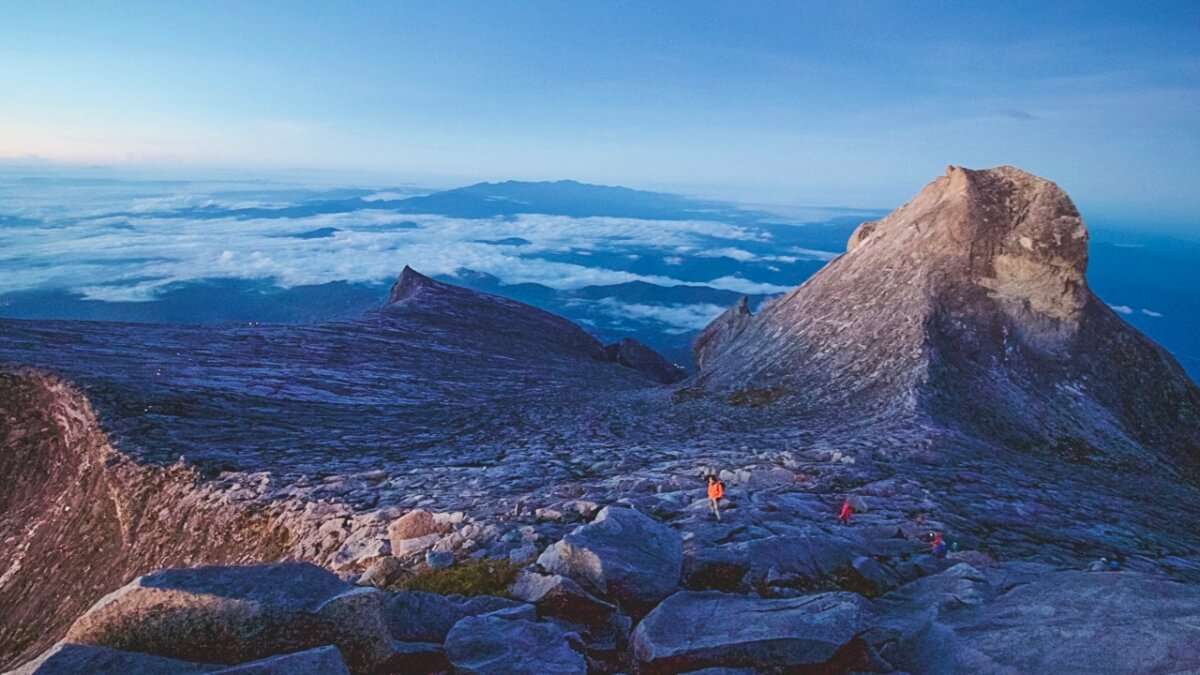
Kinabalu's summit is essentially a large granite block. It's a relatively young mountain (10 million years old) and continues growing at about 5mm annually…!
Climbing Mount Kinabalu requires no technical equipment as it presents no significant difficulties beyond the considerable elevation gain. The mountain is equipped with 2 mountain lodges at Laban Rata, at 3,266 metres.
Only 135 permits are issued daily and you must be accompanied by an authorised guide. The route to Laban Rata is well-equipped with 7 rest stations featuring toilets and waste facilities. Unfiltered drinking water is available at almost all shelters. The final stretch from Laban Rata to the summit is less developed but well-managed. At certain points, ropes assist climbers on the non-slippery granite slab, which is never excessively steep. Alternatively, two via ferrata routes are available for the descent from the summit.

DAY 1
Timpohon Gate (1,839 m) – Laban Rata (3,266 m)
Distance: 6.7 km
Average gradient: 21%
Elevation gain: 1,429 m
Elevation loss: 29 m (entrance steps and little more)
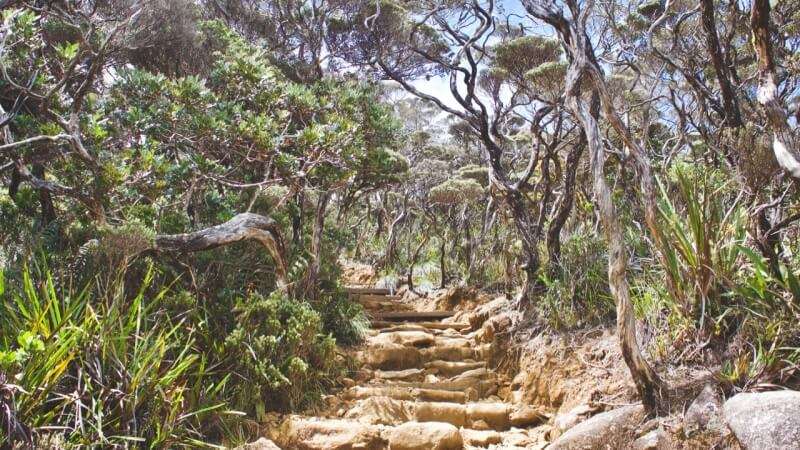
Day one typically begins at 9 am. You follow the continuously ascending trail towards Laban Rata, punctuated by 7 rest stations. Helicopter landing platforms have been installed along the route for emergency situations. The climb is relentless but not excessively demanding. The manageable distance means you can reach Laban Rata around 3 pm.
Laban Rata comprises solely two lodges and support facilities. The principal shelter provides
Share
A Piedi Per Il Mondo
New articles on walks, trekking and hiking trips. Free, no spam.
Turn this inspiration into a real journey.
Tell us about your dream walk: we will build the itinerary together.