Trekking in South Korea: A National Passion for Walkers
Discover trekking in South Korea—an extraordinary adventure through thousands of kilometres of coastline, pristine national parks, and hidden island gems. Immerse yourself in nature on one of Asia's most rewarding walking destinations.

In this article
South Korea is a fascinating country, often overshadowed by Japan's ancient history and China's vast scale. In reality, the Korean peninsula offers an excellent blend of culture, history, cuisine and above all, incredible trekking opportunities in a nation that has made walking its national sport.
South Korea is increasingly renowned for its technological innovation, but beyond the global corporations that have conquered world markets, there remains a country deeply connected to nature, thanks to thousands of kilometres of coastline, impressive national parks and countless islands scattered across its surrounding seas.
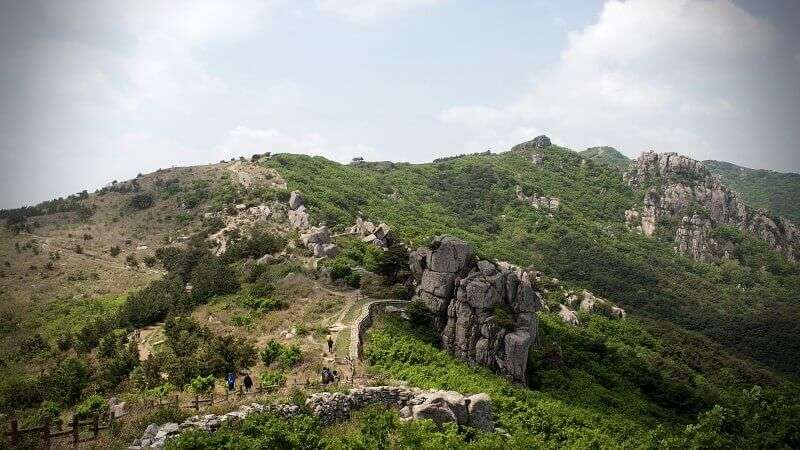
It is precisely these national parks that provide the backdrop for South Korea's finest trekking experiences. Korea's national park system has been developing since 1967, and today comprises 22 protected areas, divided between mountain parks (the majority), marine and coastal parks, and the historical Gyeongju park. The state-run Korea National Park Service manages 21 of the 22 parks and was established in 1987. Their website is exceptionally well-designed and allows you to book camping and mountain shelters operated by the service within the parks where available. Beyond parks managed by the Korea National Park Service, South Korea is dotted with smaller parks equally worthy of exploration, managed at regional level.
Typically, parks do not charge entry fees for hikers, only for vehicles and certain services such as camping, shelters, showers and professional photographers.
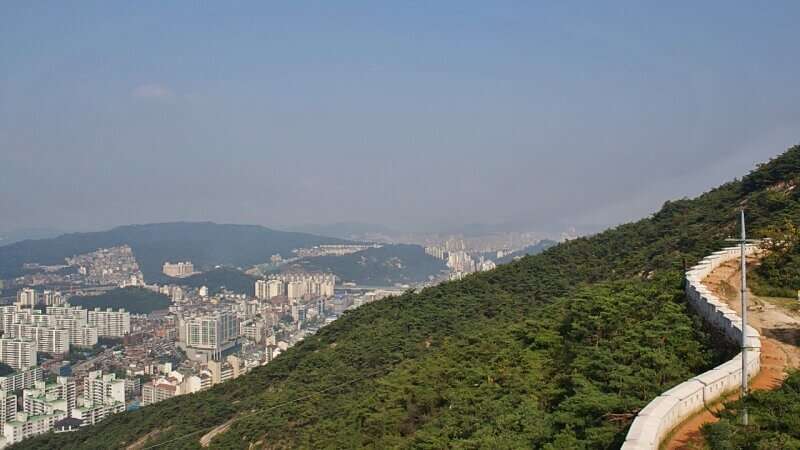
Every park is exceptionally well-maintained and the trail signage is typically excellent quality, featuring elevation profiles and route options at every junction. Signs are usually bilingual in Korean and English, so communication shouldn't be an issue. The most striking aspect of Korean parks is how actively they are used: Koreans are passionate nature lovers and devoted to their national parks, particularly on weekends, arriving impeccably equipped (the average Korean hiker's technical gear level is remarkably sophisticated, you have to see it to believe it). Despite often insurmountable language barriers, locals will never hesitate to help you—you can count on it!
It's worth noting that South Korea will host the next Winter Olympics (9-25 February 2018) in the north-eastern zone of the peninsula. For this occasion, railway and major road infrastructure improvements are underway, which will make previously less accessible areas easier to reach even after the Games conclude. Another excellent reason to visit (or return to) Korea!
Some parks are more suitable than others for inclusion in an international tourist's travel itinerary.
Seoul and Bukhansan National Park, a trekking idea in South Korea
The Bukhansan National Park (북한산국립공원, Mountains North of the Han River) is located in the Seoul region and is easily accessible by metro from the city centre. It's the most practical option because you can stay in the city and make day trips to the park without losing precious holiday time.
The park covers an area of 80 km² and was opened in 1983, then renovated in 2010. The three major granite peaks are Baegundae (836 m), Insubong (810 m) and Mangnyeongdae (799 m). Part of the fortress wall protecting Seoul (9.5 km) runs through the park, originally constructed in 132 AD and enlarged in 1711.
It's so heavily used by walkers that sections are periodically closed to protect the natural environment. A 70 km equipped loop trail runs around the park perimeter, divided into 21 sections. The park is accessible year-round and welcomes approximately 5 million visitors annually. Interestingly, it holds the Guinness World Record for the national park with the highest visitor density per square foot.
Seoul city itself offers much for walkers and is an excellent opportunity for urban trekking in South Korea. The most interesting route is the historic fortress wall. Seoul still has many restored sections of the wall that once protected the city from invaders. It was constructed in 1396 and completed over 30 years. Various additions were made in subsequent centuries until 1700. The marked trail was reopened to the public in 2006 and is particularly popular with local residents.
Parts of the route pass through military areas protecting government residential complexes (Seoul is just 2 hours from North Korea!), so expect multiple checkpoints (bring your passport!)
The trail is 19 km long with a maximum elevation of 342 m, representing an excellent example of preserving extensive natural space within an urban setting.
Gyeongju Historical National Park
Gyeongju Historical National Park is located not far from the port city of Busan and holds significant historical and archaeological importance from the Shilla period. The historic centre of Gyeongju city has been a UNESCO World Heritage Site since 1979. The protected area includes historic structures such as Bulguksa Temple and, especially, Mount Namsan park, an excellent trekking destination.
Jeju Island
South Korea's largest island is the best option for multi-day trekking in South Korea. It offers two main alternatives: the Hallasan National Park, with trails leading to the summit of Hallasan (1,950 m), and the Jeju Olle, a nearly 400 km trail circumnavigating the entire island, complete with a passport system for stamping and an association ensuring trail maintenance and organisation. For this experience, follow our posts in the coming months!
General information about South Korea
South Korea is easily accessible from Europe. The main airport is Incheon, a major international hub connected to Seoul by a convenient direct train. Seoul has its own airport closer to the city, from which many domestic flights and regional services depart.
No visa is required to enter South Korea, and the public transport network is efficient and easy to use. Tourist areas are well-signposted in English, and in any case, Koreans are a remarkably friendly people who will go out of their way to help you regardless of language barriers.
Korean cuisine is very spicy (genuinely, very, very spicy). It's wise to ask for sauces to be served separately so you can adjust the heat to your preference. The most readily available dish is bibimbap, rice topped with egg, preserved vegetables and dried seaweed. However, the true national ingredient is kimchi, a vegetable condiment (there are more than 180 varieties) originally used as a preservation method. It is, quite literally, everywhere—in every dish and at every meal. Needless to say, it's spicy.
South Korea has a climate that is predominantly cold in winter and warm in summer. Seoul can be covered with heavy snow during winter months, so prepare accordingly. Summers are perhaps less bearable than the harsh winters, so ideally plan your trip for October through November or February through June. Spring is obviously the ideal season. The exception is Jeju Island, which enjoys a more temperate climate and can be visited year-round.
What to see in South Korea
A trip to Korea typically begins and ends in Seoul, a true megalopolis. Beyond the obligatory historical monuments, it's rewarding to explore recently constructed attractions that are absolutely worthwhile.
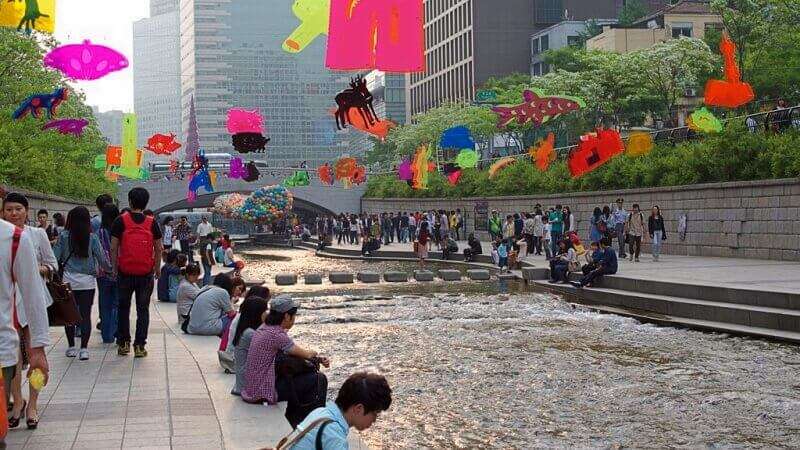
One must-see is the Cheonggyecheon (청계천), a 10.9 km route through the city centre—the perfect opportunity for urban trekking in South Korea. It's the result of an outstanding urban renewal project that revitalised a watercourse that had been covered by an elevated highway during the economic boom years. The project, launched in 2003 and costing $380 million, was initially controversial but since its opening in 2005 has earned considerable appreciation from residents and visitors alike.
Removal of the elevated expressway coincided with restructuring the area's transport system to prevent circulation problems. Public transport usage increased and pollution levels consequently decreased.
The presence of the waterway has led to the repopulation of many bird, insect and fish species. Moreover, the area has reduced local temperatures by approximately 3.6°C compared to other parts of Seoul. The river's presence has revitalised surrounding zones and numerous commercial and recreational activities have emerged.
The second highlight is the very recent Seoullo, opened just weeks ago. Again, this urban route was created from existing infrastructure, though notably dated and out of harmony with its surroundings.
Whereas Cheonggyecheon involved demolishing a road, Seoullo retained the 1970s-era road but revitalised it, transforming it into an elevated pedestrian path. It was completely renewed through the introduction of 254 plant species, rest areas, benches and even foot basins (a true Korean passion!).
The 1 km route cost $53 million and aims to revitalise a relatively underdeveloped urban area. A Korean take on the High Line, essentially.
Not far from Seoul, in Suwon (reachable by metro), you can visit the interesting Hwaseong Fortress.
To complete your Seoul experience, consider staying in a traditional Korean house, called a hanok: it's built around a central courtyard and features underfloor heating powered by steam, thanks to a centuries-old system constructed beneath each house. There are at least 30,000 throughout South Korea, with 10,000 in Seoul alone, and many have been converted into welcoming family-run guesthouses. To learn more about hanok, visit the town of Jeonju, in the south-western quadrant of the peninsula: a genuine village of well-preserved, authentic hanok.
If Seoul is South Korea's economic capital, Gyeongju (see its national park) is the historical capital and certainly deserves a visit. It's the Korean city with the highest concentration of historical sites. The area is primarily tourist and agricultural (rice) oriented. The historic centre contains the tombs of Shilla kings (1st century BC–2nd century AD), artificial grass-covered mounds. It's less than an hour's travel from Busan.
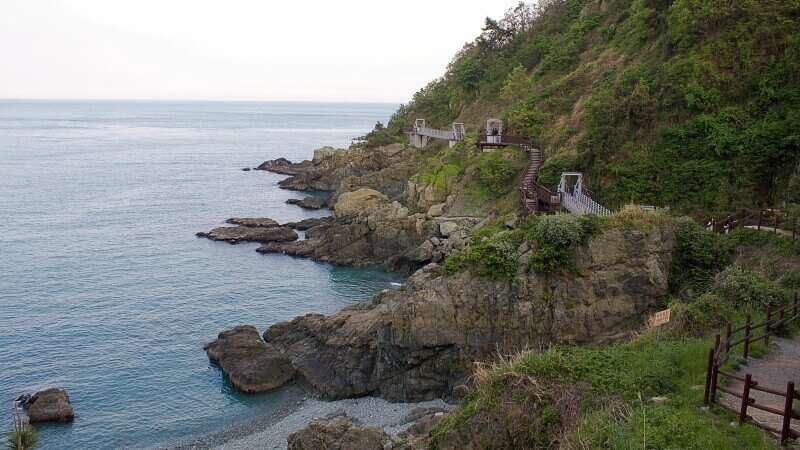
Busan in particular is a port city also visited for its beaches. It's 3 hours by ferry from Fukuoka, Japan. The city is human-scaled and provides easy access to coastal urban parks (with beautiful sea-level trails) and regional natural parks. Beyond these two areas, in the north-eastern zone of the peninsula you can take advantage of excellent ski facilities at Pyeongchang (host to the 2018 Winter Olympics) or explore the temples of Sobaeksan National Park (including overnight stays with monks).
South Korea represents a highly interesting alternative to classic oriental destinations, and with its blend of cities and natural parks, you'll certainly have no shortage of captivating experiences!
Share
apiediperilmondo by wayure
New articles on walks, trekking and hiking trips. Free, no spam.
Redazione
La redazione di Apiediperilmondo. Guide, itinerari e storie nate camminando: consigli pratici, cammini in Italia e nel mondo, letture e spunti per chi viaggia a piedi.
Profilo e tutti gli articoli di Apiediperilmondo