Trekking in Malaysia's Rainforests: Discover Taman Negara
Malaysia offers unforgettable trekking experiences where ancient rainforests, pristine beaches, and untamed wilderness converge. Venture into Taman Negara and uncover the magic of one of the world's oldest jungle ecosystems.

In this article
Malaysia is a destination suited to many types of travel. It has beaches, stunningly beautiful and paradisiacal, it has cities, rich in history and culture, and above all it has abundant nature, in some cases untouched. The tropical climate makes the country suitable for visiting year-round; expect constantly high temperatures and daily rainfall that provides some relief. It is precisely this abundance of humidity and water that allows vegetation to grow lush and verdant. The ideal approach is therefore to plan a trip that allows you to experience all the different facets of Malaysia, starting with its parks.
Trekking options in Malaysia
Upon arriving in Malaysia by air, the first thing that strikes you is the abundance of greenery. The country is home to 30 national parks, divided between the peninsula and Malaysian Borneo. Malaysia offers various trekking destinations that allow visitors to truly connect with nature, the undisputed star.
Focusing on the locations of greatest interest to an international traveller, there are three main destinations:
- two on the peninsula – Cameron Highlands and Taman Negara National Park
- Malaysian Borneo.
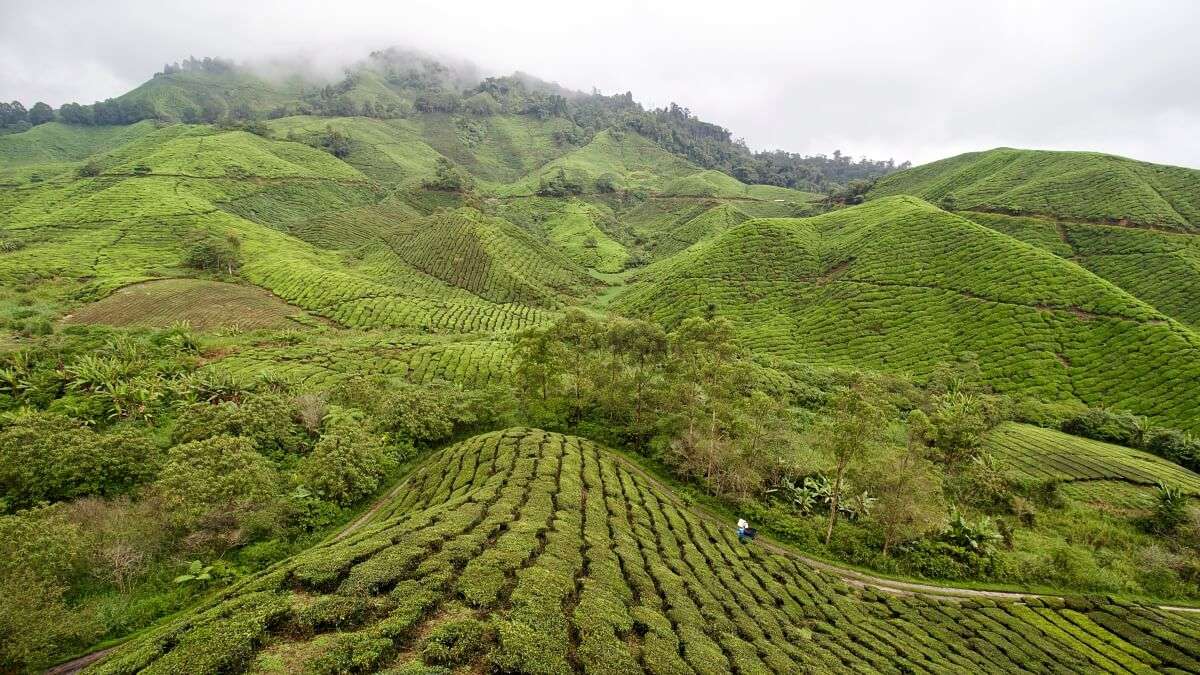
Cameron Highlands is a hilly region at higher elevation than the rest of Malaysia, which long provided respite from the heat for the English residents of Kuala Lumpur. The architecture of the area is typically English (white houses with wooden trim, fireplaces and carpeting everywhere). The true appeal of the region, however, are the tea plantations originally planted by the British and still an important source of income. Being set within nature, it provides an ideal backdrop for walks through tea fields, dense forests and… English cottages!
Malaysian Borneo deserves a journey of its own: trekking options are numerous and culminate in the ascent of Mount Kinabalu (read our upcoming articles to learn more!).
The rainforest of Taman Negara National Park: a trekking option in Malaysia
Taman Negara National Park represents one of the three most interesting trekking options in Malaysia. It encompasses the Titiwangsa Mountains and was established in 1938 under the name of King George V National Park, before being renamed Taman Negara (“national park” in Malay) following independence.
It covers an area of 4,345 km² spread across three states (Pahang, Terengganu and Kelantan), but only 15% of the park is accessible—the rest is the realm of wildlife!
At over 130 million years old, it is often mistakenly considered the world's oldest rainforest: it is certainly older than the Amazon, but the world record for age most likely belongs to the Daintree rainforest in Queensland, Australia.
The park includes the highest peak of continental Malaysia, Mount Tahan (2,187 metres), and is home to animals such as the extremely rare Malayan tiger, the equally rare Asian elephant and macaques. Among the birds, the ubiquitous hornbill can be found.
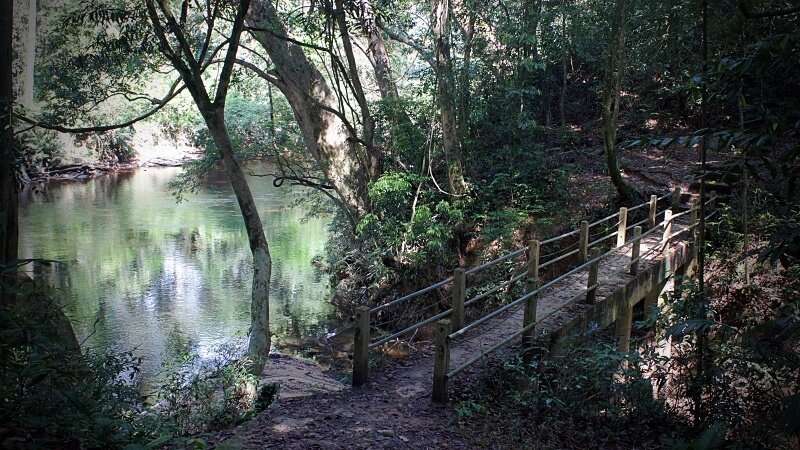
It also hosts 1,400 plant species, including orchids, ferns and the famous rafflesia. It is watered by two rivers: the Sungai Tembeling, muddy and turbulent after rains, and the serene and enchanting Sungai Tahan, a tributary of the former.
The average annual temperature is 27 degrees Celsius, and the rainy season lasts from October to January.
The park is inhabited by approximately 1,500 indigenous people of the Batek and Semokberi ethnic groups. They are nomads who primarily dedicate themselves to hunting. Europeans first "noticed" them in 1878. They belong to the group known as the Negrito, an ethnic group of confirmed African origin (as is evident from their physical features).
Taman Negara is accessible from the village of Kuala Tahan by boat (a 5-minute crossing of the Sungai Tembeling). Departures are very frequent. Within the park, at the entrance, there is the only hotel.
The park is well organized with a visitor centre equipped with a ticket office, refreshment area and shop selling food and other goods. At the ticket office (and through the hotel) it is possible to hire an authorized guide, which is essential. Finding a guide on-site is advisable only if you plan to stay in the park (overnight at the hotel or in Kuala Tahan guesthouses) for at least one night, as guides are usually made available for the following day. If you plan to visit the park only as a day trip, think carefully about what to do and arrange a guide in advance. That said, it is highly recommended to spend at least one night in the park to take full advantage of the surrounding nature and to undertake longer and more challenging trails.
The park's attraction suitable for everyone, and what everyone chooses, is the Canopy Walkway, located 2 km from the entrance: a system of suspended rope bridges at 45 metres height for 510 metres length that allows you to walk at the level of the tree canopy, suspended over the jungle.
The project was completed in 1992 and is today the world's longest Canopy Walkway of its kind. It is enjoyable and well worth experiencing. If you plan to limit yourself to this activity, a guide is not necessary.

The park is unique whether trekking along its trails or admiring its vegetation from the waterways that flow through it. It is therefore essential to combine trekking with a return to base by boat (your guide, if forewarned, will manage this for you). The boats are small canoes for 2-3 people that glide lightly over water turned amber and crystalline by tannins released from submerged branches. It is not uncommon to spot monkeys leaping from branch to branch as you drift slowly by.
You can arrange with your guide the route you prefer to take (based also on terrain accessibility, sometimes made impassable by rain). A highly worthwhile destination is the Lata Berkoh rapids, approximately 12 km from the park entrance.
The trails vary in length, typically between 10 and 20 km. Elevation gain is normally minimal though never absent.
The temperature is very high, which perhaps constitutes the greatest difficulty, along with leeches, charming little creatures that will attach themselves to your legs, shoes and trousers. Your only option is to tolerate them and remove them with a sharp flick, ignoring the blood that seeps from the bite. Think about it—there are people who pay to undergo regenerative therapies of this type...! Gaiters exist that protect against these attacks, but the heat may discourage you from trying them. It is all part of the experience!
Taman Negara also offers a multi-day trekking option: the ascent of Mount Tahan in 4-7 days depending on your chosen route. In this case, it is essential to organize well in advance to engage a suitable guide and prepare with the necessary provisions and equipment.
When to go
Rain. Malaysia is green for a reason: it rains. However, it is rain that serves a purpose, breaking up the hot and sunny days, and does not ruin your holiday. Despite rainfall being constant, there are periods when it rains more: December to February on the east coast.
The ideal period is March to June, when both coasts are spared from heavier rainfall. In any case, you will never experience cold in Malaysia, except perhaps in some higher elevation areas with pleasantly cooler temperatures. The tropical heat is also part of the adventure!
What to see
After a few days of trekking in Malaysia, there is much to see in this large country.
First of all, the Malay Peninsula is very suited for driving. An international driving permit issued in Italy allows you to drive in the country without issues and gives you considerable freedom in terms of movement and scheduling.
It is very likely that your journey begins and ends in Kuala Lumpur, the capital, where it is advisable to spend at least a full day. It is a very green city but more hectic than the local average. It is rich in history although its symbol is the modern Petronas Towers, which dominate the skyline. Among the must-see attractions: the Petronas Towers, Merdeka Square, Central Market and the Batu Caves just outside the city.
A few hours' drive from KL you can reach interesting locations that merit a visit:
- To the southwest you'll find Malacca, the cultural capital of Malaysia. The historic centre is dotted with buildings in Peranakan style, and the heart of the city is represented by the remains of Portuguese rule, who stayed here for 130 years between the 16th and 17th centuries: they left behind a church and fortress of great historical interest. Noisy and brightly lit rickshaws hunting for passengers have become part of the city's landscape.
- To the northwest, it is worthwhile to spend a few days on Penang Island, which also hosts beautiful beaches and a rather impressive nature reserve. Penang's main attraction is Georgetown, the historic heart of the island.
In both Malacca and Georgetown it can be interesting to stay in a historic building, often a merchant's house or former colonial dwelling now converted into a small hotel.
- To recover from the exertion and return to more acceptable temperatures, it is recommended to spend a couple of days in Cameron Highlands (see Trekking options in Malaysia), if only to visit the tea plantations and enjoy a basket of strawberries, a true local specialty.
- The most coveted beaches are mostly along the east coast. The best according to many are the Perhentian Islands to the north, and the Tioman Islands to the south. On the west coast, a good option is Langkawi Island in the far north near the Thai border.
Borneo truly deserves a separate trip, so we invite you to read our upcoming posts!!
Some information about Malaysia
Malaysia is a tropical country, a few hundred kilometres from the equator, inhabited by 30 million people. One of the most interesting aspects of Malaysia is its multiculturalism.
The population belongs primarily to three ethnic groups: Malays (61.4%), Chinese (24.6%) and Indians (7.1%). Among minorities (6.9%), the Peranakan Chinese (Straits Chinese) are the most numerous. The languages and dialects spoken number over 100.
From a religious perspective, Malays are Muslim by birth but remain deeply connected to local traditions and the kampung (villages) of their origin, where elders hold leadership roles and the figure of pawang (shaman) still exists.
Malaysia is officially a Muslim country, a characteristic that influences many aspects of daily life (for example banks and public offices close for two hours on Friday for prayers). Syariah (Sharia in Malay) is in effect. In the past, religious celebrations were attended by practitioners of various faiths, but in recent years this has unfortunately become less common.
The Chinese arrived on the peninsula starting in the 15th century, primarily from Fujian (the Chinese coastal province facing Taiwan), Guangdong (the province of Canton, bordering Hong Kong) and Hainan (the southern island province).
The Peranakan Chinese (literally “descendants”) are the descendants of immigrants who arrived from China beginning in the 16th century, settling in Malacca, Penang and Singapore and marrying Malay women. It could be said they inherited their name and religion from their fathers while traditions, language and clothing from their mothers. They were usually wealthy merchants who could afford spacious residences painted in brilliant colours and furnished with intricately carved furniture (do not miss those in the historic centre of Malacca).
In the 19th century they developed close ties with the English, and particularly the men began wearing Western dress. They speak a dialect of their own, difficult to understand even for Malays.
The Indians are of Hindu, Muslim, Sikh and Christian origin. The majority are Tamil (from the Indian Tamil Nadu state with a Hindu tradition). Indians are largely employed as low-cost labour, although there is an English-speaking minority active primarily in commerce.
The indigenous Malays are known as Orang Asli (literally “original people”), now limited to approximately 150,000 people, 80% of whom live in poverty (nationally, 8.5% of the population lives in poverty). They are Australoid and are believed to be among the oldest ethnic groups in Southeast Asia.
This ethnic mix obviously influences the local cuisine, which draws inspiration from Indian, Chinese and Southeast Asian traditions. Apart from the freshest tropical fruit, available everywhere, you absolutely must try the hundreds of dishes offered by street vendors, a true feature throughout the country. Kuala Lumpur is certainly an excellent base for discovering all the nuances of Malaysian cuisine!
Historical background
Malaysia's history is inextricably linked to its strategic position between Europe, the Far East and Southeast Asia. Over the centuries, Indians, Buddhists from Sumatra, Muslim merchants and Chinese (beginning in the 14th century) followed one another.
Among the cities, Malacca quickly acquired a unique role due to its position controlling the strait of the same name. It became the hub of commerce between India and China and surpassed all others. In the 16th century the Portuguese arrived, followed by the Dutch (who later relocated to Indonesia) and finally the English (who established Penang as the operating base of the East India Company).
In 1824, the English and Dutch signed a treaty defining spheres of influence in the region: Indonesia went to the Dutch, Penang, Malacca, Dinding and Singapore to the English (the so-called Straits Settlements). Over time, however, the settlements became actual colonies, later united in the Federated Malay States (1896), governed by English representatives.
After the Japanese interlude (from 1941 to 1945 Tokyo conquered the entire peninsula, killing thousands including Westerners, Chinese, communists and intellectuals), the English began to give more weight to local independence demands: the Malayan Union (1946) was quickly converted into the Federation of Malaya (1948), which re-established the sultans' prerogatives.
Formal independence came in 1957. The new federal state initially included Singapore (but it withdrew in 1964 because it did not want to extend to Malays the constitutional privileges it had acquired).
The difficulty of coexistence between Malays and Chinese was deeply felt throughout the peninsula. The Chinese did not accept Malay predominance in institutions, while Malays rejected Chinese predominance in commerce. In 1969, protests erupted in Kuala Lumpur where hundreds of Chinese were killed (the “May 13 Incident”).
Today Malaysia is a rather tolerant multicultural country, although the major ethnic groups often remain separate from one another (both in education and marriage). The Chinese, however, remain largely excluded from government, which creates tensions.
Share
apiediperilmondo by wayure
New articles on walks, trekking and hiking trips. Free, no spam.
Redazione
La redazione di Apiediperilmondo. Guide, itinerari e storie nate camminando: consigli pratici, cammini in Italia e nel mondo, letture e spunti per chi viaggia a piedi.
Profilo e tutti gli articoli di Apiediperilmondo