Bitonto Cathedral: A Masterpiece of Puglian Romanesque
Where East meets West, Bitonto Cathedral stands as the finest expression of Puglian Romanesque architecture, a spiritual and architectural treasure waiting to be discovered on foot.

In this article
Anyone who approaches the world of art as a tourist cannot help but be captivated by the fascinating and mysterious world of symbolism. Knowing and discovering the meaning concealed behind images allows us to understand more consciously what we are looking at. It is a field of study that is always evolving, open to a thousand interpretations and theories. It is therefore difficult for non-specialists to have a complete and exhaustive picture of the work of art they are admiring.
Although there are countless elements we will not cover here, after this brief description the Cathedral of Bitonto will certainly feel more familiar and comprehensible to you.
Let us now take a step back and better understand the historical context in which the Cathedral of Bitonto was conceived and built.
Why Apulian Romanesque? The historical context of its birth
The Cathedral of Bitonto, the supreme expression of Apulian Romanesque, is one of the finest testimonies to a past that was Apulia's own, halfway between East and West.
Apulia, conquered by the Romans during the third century, immediately began to play a leading role in trade between Rome and the Eastern markets. Its rich production of oil and wheat, combined with its privileged position in the Mediterranean, made it a perfect bridge between two worlds. Subjected first to the Normans and then to Byzantine rule between the ninth and eleventh centuries, it saw its "cosmopolitan" character become ever more pronounced. This was soon reflected in a truly unique artistic and architectural language that found expression in Apulian Romanesque.
History of the Cathedral of Bitonto
The year in which the Cathedral of Bitonto was built remains unknown to this day. No document or written testimony attesting to its design and construction has yet been found. Everything we know derives from the study of the cathedral itself.
Between 1991 and 1999 an extremely important piece was added to the history of this building. Beneath the flooring of the central nave, the remains of an ancient basilica dating from the fifth to sixth century were discovered. The findings suggest that this ancient building survived until the eleventh century. But how can this be established? From the discovery, in the same excavation, of a magnificent mosaic dating from the very beginning of the eleventh century, in the Norman era, and of architectural remains showing the intention, never carried out, to construct another building over the ancient basilica.
The construction of today's Cathedral of Bitonto is dated to around the twelfth and thirteenth centuries, an estimate reached by studying the styles and influences of the facade, the interior and the decorations.
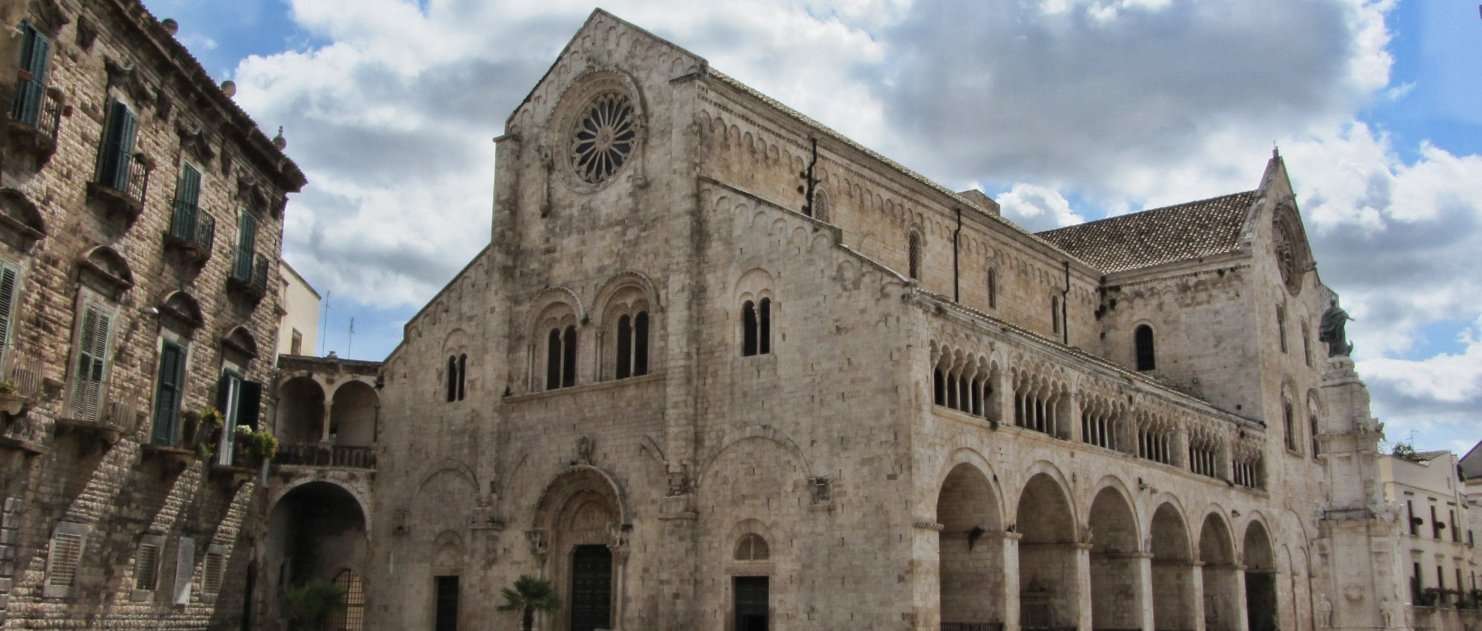
The facade of the Cathedral of Bitonto
Dedicated to Saint Valentine and the Assumption of Mary, the Cathedral of Bitonto has in its majestic facade an element of great distinction.
Two pilasters (slightly projecting from the wall) placed on the facade in line with the walls of the central nave project outward the movement of the three naves.
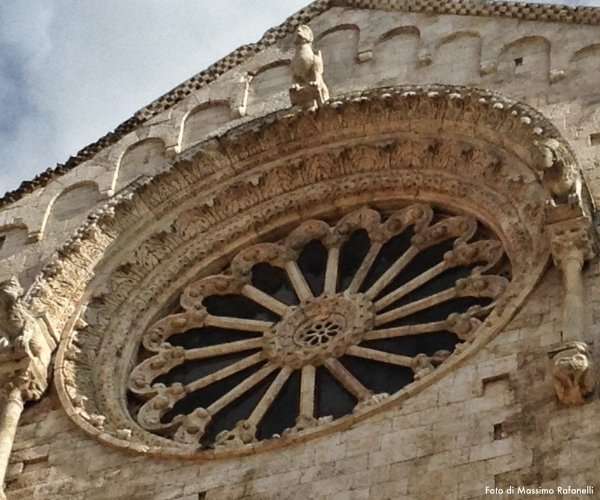
The magnificent rose window, positioned at the top centre of the facade, features two small columns surmounted by two lions, which together support the archivolt of the rose window. Above it stands the statue of a sphinx: a legendary creature with large wings, a human head and a leonine body.
The porch and the theme of Salvation
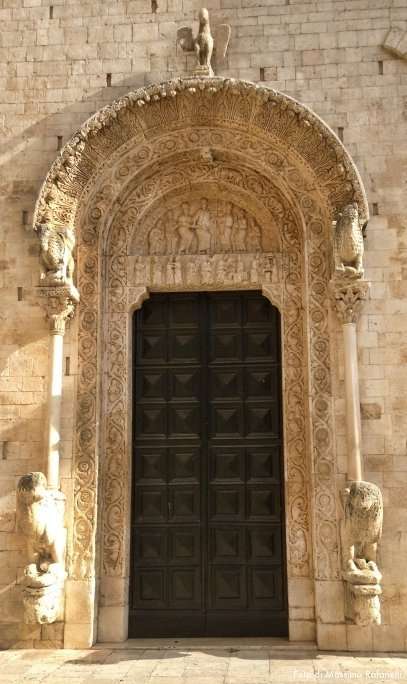
The true protagonist of the facade of the Cathedral of Bitonto is however the central portal. Richly decorated, its bas-reliefs and statues represent the theme of Salvation.
The architrave and the lunette above it together represent the Revelation.
On the architrave we see the four cardinal scenes of the Childhood of Jesus, moments in which his divine essence is "revealed".
- The Annunciation, with the figures of the Archangel Gabriel and Mary.
- The Visitation, with the meeting between Mary and her cousin Elizabeth.
- The Adoration of the Magi.
- The Presentation at the Temple, a ceremony held at the Temple in Jerusalem 40 days after the birth of Jesus.
The theme of Salvation is finally fulfilled with the images of the Anastasis on the lunette. A representation typical of Byzantine art, the scene illustrates the descent of Jesus into Hell and the consequent liberation from sin of the righteous souls who died before his Sacrifice.
At the top, on the archivolts, stands the pelican statue. This African bird with its long beak was elevated to a symbol of charity, love and sacrifice, becoming in medieval literature and iconography a personification of Jesus. Cf. Dante, Paradiso, Canto XXV, verses 112-114.
The origin of this symbolism derives from the image of the pelican curving its beak to feed its young. Today we know that this movement allows the chicks to take food from the pouch under the parent's beak. In medieval times it was instead a widespread belief that it fed them with its own flesh, an image very close to the sacrifice of Jesus on the cross.
Interior of the Cathedral of Bitonto
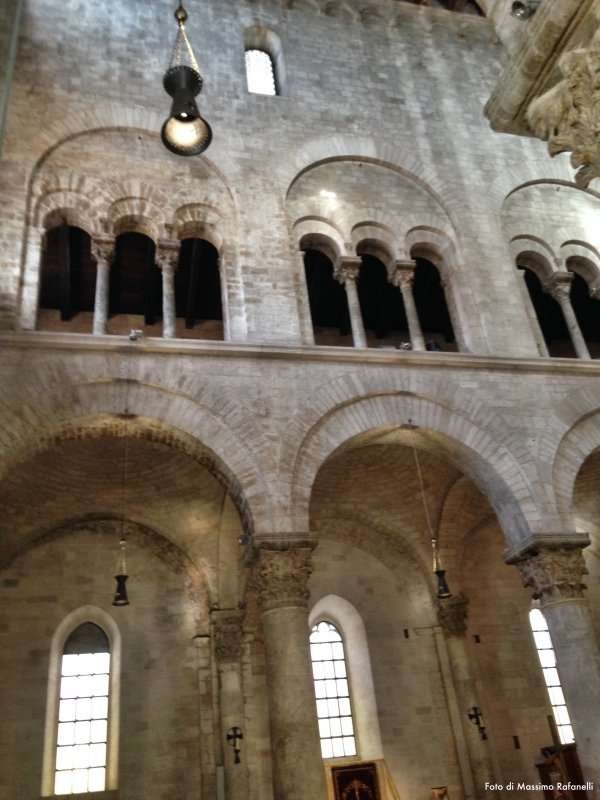
The Cathedral of Bitonto is internally divided into three naves. Along the central aisle, on a raised level, a magnificent matroneum opens on both sides, a gallery reserved for women.
Here too, numerous exchanges between Eastern and Western culture are evident.
Fantastic animals, lions, monkeys and exotic vegetation contribute to a theological theme: the ascent of man towards goodness.
On the right, between the second and third arches, we find the cap of the baptismal font. Divided into bands with intertwined vine shoots and palms resting on a fleur-de-lis base, it is the work of Nicolaus, a celebrated priest and architect.
The Ambo and the bas-reliefs of the parapet
The Ambo, the balustrade with a lectern, definitely dates from 1229 and is also the work of Nicolaus. Richly inlaid and decorated, it is composed of various symbolic elements.
On its sides, two small columns are surmounted on one side by an ox, representing Saint Luke, and on the other by a Lion, symbol of Saint Mark. In the centre a human figure, that of Saint John, supports a powerful eagle, which in turn is surmounted by a magnificent lectern. Its refined decoration draws on Sicilian, Campanian and Byzantine models.
On the parapet of the stairway leading to the Ambo we find a triangular slab of great value. The bas-reliefs represent four figures, three standing and one seated. Although some identify in it the royal dynasty of Frederick II of Swabia, others suggest that the figure seated on the throne is a woman. The feminine hairstyle and crown would confirm this. She would represent the city of Bitonto in the act of handing the sceptre of power to a messenger of King Frederick II, who would be at the centre of the scene, wearing a crown.
The subsoil and the rediscovered mosaic
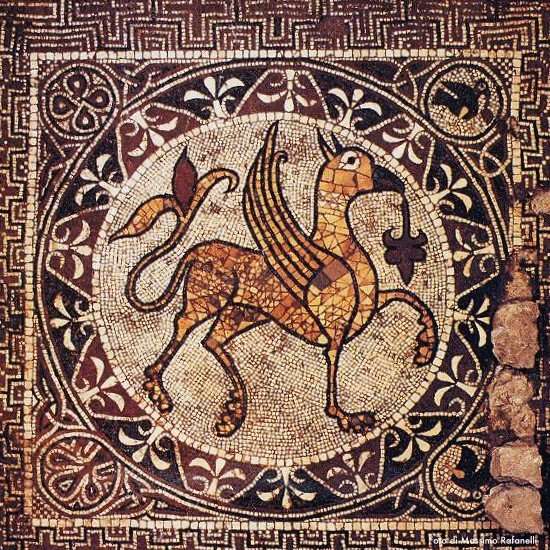
As mentioned earlier, in reference to the recent discoveries beneath the building, the Cathedral of Bitonto can boast a magnificent floor mosaic still perfectly preserved.
Dated to the mid-eleventh century, it depicts a winged griffin, with a flower hanging from its beak. A legendary animal with a bird's head and a lion's body, it symbolises the simultaneously earthly (lion) and divine (eagle) nature of Christ.
Composed of limestone and marble tesserae, the mosaic uses very bright and vivid colours. The most frequently used are white, red, grey, black and yellow.
Share
apiediperilmondo by wayure
New articles on walks, trekking and hiking trips. Free, no spam.
Co-fondatrice, Apiediperilmondo
I've been organising walks since I discovered that walking slow is the fastest way to know a place. I take care of every logistical detail so you can focus only on the steps ahead.
Profilo e tutti gli articoli di Deborah