Castel del Monte
A UNESCO World Heritage fortress where East meets West. Castel del Monte captivates walkers with its harmonious blend of Arab, Northern European, and Classical architectural influences.

In this article
Castel del Monte stands as one of the finest expressions of Frederick II of Swabia's eclectic personality, a pivotal figure in Italian history and particularly in the development of southern territories.
Let us explore his remarkable legacy.
Frederick II of Swabia and the Economic and Intellectual Growth of the Kingdom of Sicily
Frederick II of Swabia, King of the Kingdom of Sicily, of Germany, and Emperor of the Holy Roman Empire, was born in 1194 in Jesi. Orphaned at a young age, he spent his formative years at the court of Palermo, the kingdom's capital, until reaching adulthood. It was here that he discovered the value of cultural diversity, immersing himself in Arab and Muslim traditions, alongside countless other ethnicities and customs.
Amid internal power struggles and political tensions across Italy, Frederick II invested considerable resources in the development of Apulia.
Blessed with an enviable geographical position, ideal for commerce and Mediterranean trade, he actively encouraged the construction of a vast network of cities and castles. So convinced was he of the region's potential that in 1223 Frederick II moved the capital of the Kingdom of Sicily to Foggia.
Beyond his remarkable political and diplomatic abilities, Frederick II is still celebrated today for his intellectual brilliance, insatiable curiosity, and profound love for southern Italy.
His court constantly hosted prominent figures in the humanities and sciences. A devotee of classical and Greek philosophy, we owe to him the translation of many works by Aristotle previously unknown to the West.
A passionate falconer with a keen interest in nature, science, and mathematics, he surrounded himself with the most influential scholars of his time, notably benefiting from the knowledge of the renowned mathematician Leonardo Fibonacci.
Frederick II embodied the highest ideals of ancient Greece and Rome—a man attuned to justice, progress, and the pursuit of learning.
Castel del Monte: Location and Construction
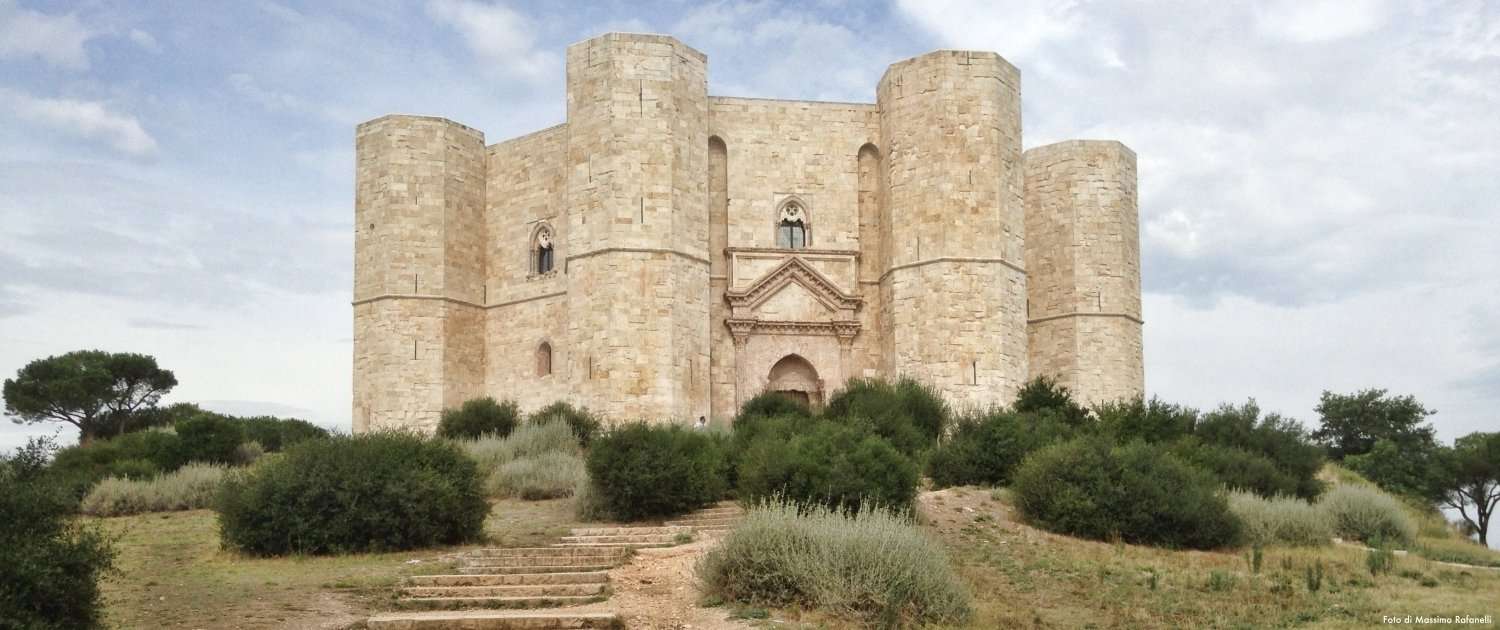
Standing just 19 kilometres from Andria and less than 30 kilometres from the sea, Castel del Monte rises majestically atop a hillside at 540 metres elevation, marking the beginning of the western Murgia plateau.
Historical documents suggest construction began before 1240, with Frederick II taking a personal interest in the project.
The Structure of Castel del Monte
Visible from all directions, even from great distances, Castel del Monte is renowned today for its distinctive octagonal form.
Eight towers, rising from eight corners, each feature 8 windows per floor. The lower floor contains 8 single-light windows, whilst the upper level displays 7 double-light windows and 1 triple-light window. The latter faces towards Andria, possibly as a mark of respect to two of Frederick's wives who died and were buried in the cathedral—Constance of Aragon and Jolanda of Brienne.
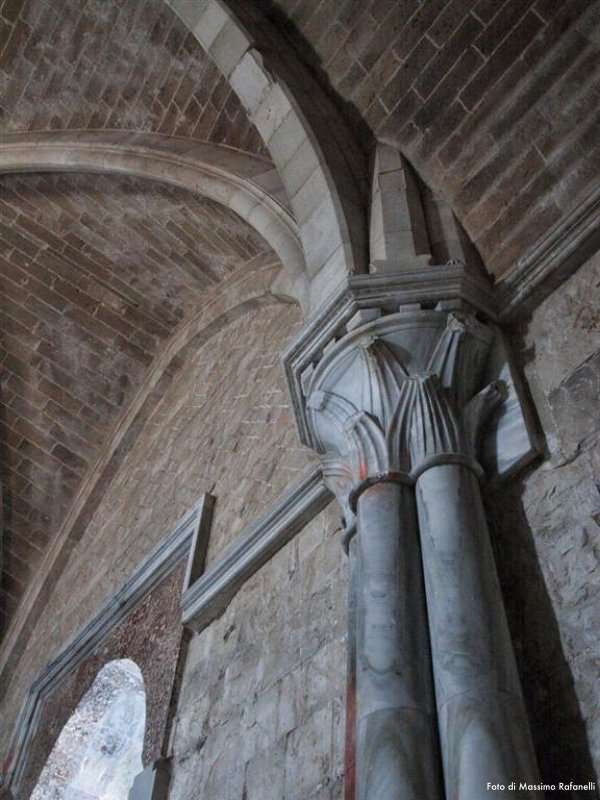
Each floor of Castel del Monte contains 8 rooms, 16 rooms in total. These rooms are trapezoid-shaped, an unusual geometry requiring innovative roofing solutions. When drawn, a trapezoid can be divided into three sections: a central square and two triangles. The ceiling of each room thus features a central barrel vault, with ribbed barrel vaults on either side.
Except for the first and eighth, all rooms interconnect. Three spiral staircases, located in corresponding rooms, link the lower floor with the upper level.
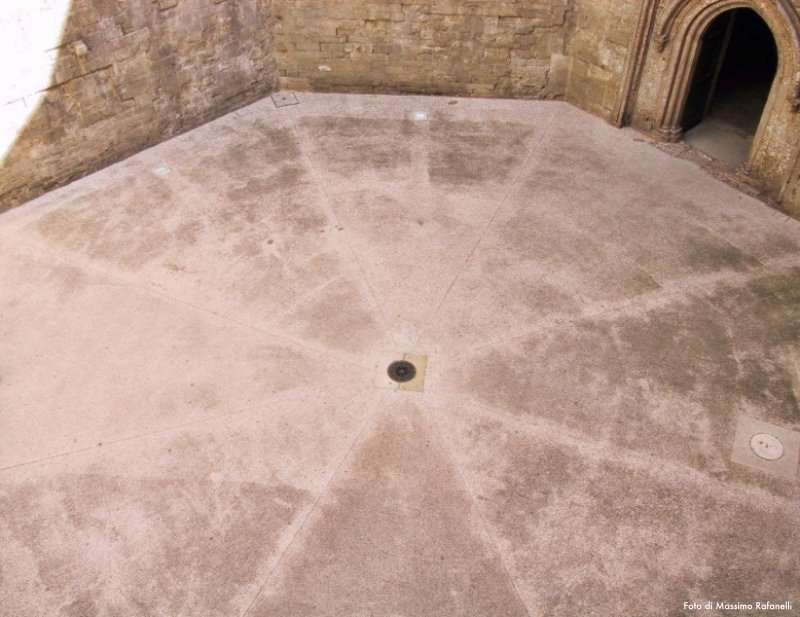
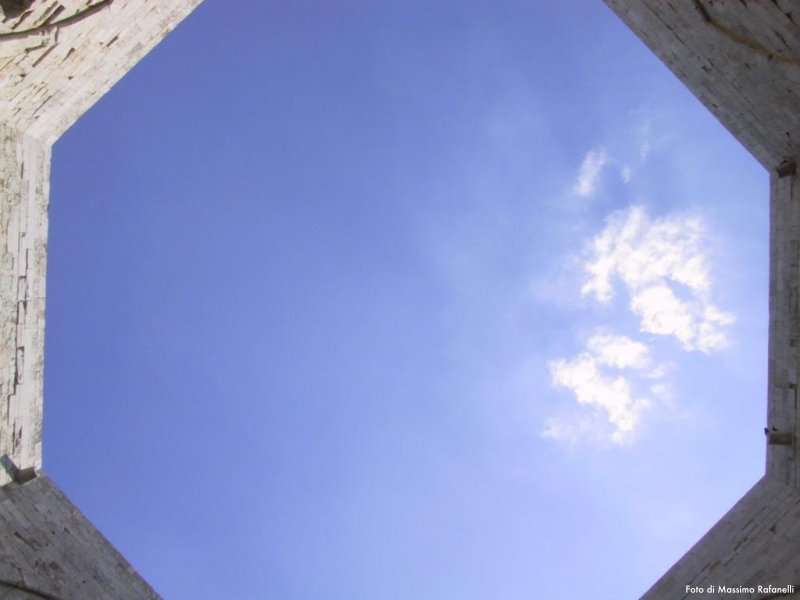
At Castel del Monte's heart lies a courtyard, modest in size, where historical accounts suggest an octagonal basin once stood. From here, gazing upward at the sky above, one experiences the sensation of standing at the bottom of an endless well.
Materials and Decorations at Castel del Monte
The castle underwent numerous restorations and modifications throughout the centuries.
Our knowledge of Castel del Monte's original appearance and structure comes largely from written accounts by 19th-century scholars. Through their records, we learn of the octagonal basin in the courtyard, and the abundant sculptures and decorative elements that once filled the rooms. Vaults were entirely covered with mosaics, marble and coloured glass, majolica tiles and statuary.
Today, we can only imagine the original splendour by admiring its structure, refined finishes, and the materials employed throughout. Alongside common limestone and marble, one can observe a striking red coral breccia.
Particularly prominent in the door frames and main entrance, this coral breccia was highly prized by Frederick II and, according to some scholars, was quarried from nearby caves in the Gargano.
A Sophisticated Water System
Castel del Monte boasts a refined system for collecting and distributing rainwater.
Beneath the rock near the central courtyard lies a large cistern. Through a sophisticated network of pipes, rainwater collected from the castle's surface and from small cisterns located on several towers was channelled here.
The other towers contained baths, wash basins, and basins for personal cleansing. Frederick II possessed a notable sense of hygiene and bodily purification, principles learned from Islamic culture and practices, such as the ritual of ablution.
Castel del Monte: Not a Fortress, but a Splendid Residence
First and foremost, Castel del Monte was not constructed for defensive or military purposes.
It lacks all the elements necessary for such use. There are no moats or drawbridges, no stables for horses or large barracks for soldiers, and the arrow slits are too narrow. The staircases spiral upwards to the left, meaning an attacker ascending could easily wield a sword in their right hand, whilst a defender descending would be at a disadvantage and virtually defenceless.
Given its lavish interior decoration and numerous ornamental elements, Castel del Monte was likely used as a residence and ceremonial seat.
Water as a Central Element: Castel del Monte as a Health Retreat
According to scholars Occhinegro and Fallacara, architects from the University of Bari, Castel del Monte functioned as a place for bodily restoration and renewal. Here Frederick II benefited from the presence of experts in medicine and alchemy, devoted to preserving his health.
Recognizing Frederick II's profound knowledge of and admiration for Eastern culture, these two scholars sought connections between Castel del Monte's unique spatial arrangement and Eastern fortified residences.
By studying the floor plans and the complex hydraulic systems and water distribution networks that characterized the entire structure, scholars have hypothesized the presence of "thermal" rooms within the castle. There would thus have been entire spaces dedicated to the frigidarium, tepidarium, and calidarium—the three phases of cold, warm, and hot water that form the basis of thermal baths.
Truly a fascinating theory to consider.
Mystical Theories Surrounding Castel del Monte's Construction
Numerous mystical theories surround Castel del Monte's construction.
Scholars have observed the mathematical proportions present in the building's architecture, which some believe relate to the golden ratio, Fibonacci's sequence, and Boethius's musical consonances.
One cannot overlook the significance of the number 8. Some associate it with infinity, symbolically represented by the figure 8 inverted.
Others interpret it as representing "New Creation," suggesting that the eighth day of Creation symbolizes spiritual rebirth through baptism.
Still others perceive in the octagon a symbol of the encounter between humanity and God: it represents a geometric form positioned between the circle, symbolizing the divine, and the square, symbolizing the earthly.
When discussing mysticism and mystery, there inevitably emerges a theory concerning the Holy Grail. Thus, the castle's form is likened to that of a colossal chalice. And why not suggest that Castel del Monte is the very place where the Holy Grail lies hidden?
In truth, countless theories surround Castel del Monte, some undoubtedly more plausible and grounded in reality than others. What remains certain is that much remains unknown about this remarkable edifice, a reality that perpetuates the air of mystery enveloping it.
Share
apiediperilmondo by wayure
New articles on walks, trekking and hiking trips. Free, no spam.
Co-fondatrice, Apiediperilmondo
I've been organising walks since I discovered that walking slow is the fastest way to know a place. I take care of every logistical detail so you can focus only on the steps ahead.
Profilo e tutti gli articoli di Deborah