Walking the Via Postumia: Aquileia to Genoa
Trek 930 km along one of ancient Rome's greatest roads, connecting the Adriatic coast to the Ligurian Sea while discovering Italy's most enchanting cities.

In this article
Table of Contents
The Via Postumia is an exceptional long-distance walking route covering approximately 930km, stretching from Aquileia to Genoa, crossing the entire northern Italy from east to west, passing through Friuli-Venezia Giulia, Veneto, Lombardy, Emilia-Romagna, Piedmont, and Liguria.
The entire first section, up to Piacenza, develops across flat plains, following secondary roads, country tracks, and cycle paths through predominantly agricultural landscapes. The beauty of this stretch doesn't lie in dramatic scenery—though pleasant—but rather in the art cities that follow one after another in rhythmic succession: Aquileia, Palmanova, Treviso, Vicenza, Verona, Peschiera del Garda, Mantua, Cremona, and Piacenza.
From Piacenza to Genoa the elevation gains become more engaging, and clambering over rolling hills becomes a tonic for the spirit. You'll immerse yourself in woodlands and connect more deeply with the surrounding nature. Here, the landscape takes centre stage—particularly in Piedmont, where vineyards blanket the hillsides in a patchwork of incomparable beauty.
Suitable for everyone and largely bikeable, this is a unique opportunity to rediscover the hidden beauty of Italy, a country whose treasures are often overlooked, yet never fails to stir the soul.
History of the Via Postumia
The Via Postumia represented one of ancient Rome's most important and strategically vital consular roads, essential for east-west connections across the Italian peninsula. The road united Genoa with Iulia Concordia, today's Aquileia, creating a bridge between the regions of Gaul and Spain with the eastern empire and Asian trade routes.
Conceived by consul P. Postumius Albinus for military purposes, the Via Postumia is dated to 147 BCE, though at that date only the Genoa-Tortona and Cremona-Julian Alps sections were completed.
The remainder of the consular road was the work of Augustus, who a century later also oversaw military fortifications in several northern Italian cities, including the magnificent Verona, which consequently arose in parallel with the Via Postumia.
The Via Postumia Today
We know the exact route of the Via Postumia today thanks to an ancient travel diary kept by a pilgrim, who on his pilgrimage from Bordeaux to Jerusalem, traversed the entire consular road. At that time, reaching the Holy Land from Gaul required crossing Italy, then the present-day Greece and Turkey, in a journey both arduous and perilous.
Historians were thus able to study the Via Postumia through this Itinerarium Burdigalense, named after the ancient name of Bordeaux, Burdigala.
Today the Via Postumia follows much of the original route, especially near the cities. However, a substantial section has necessarily adapted to practical considerations, prioritising walker safety and avoiding heavily trafficked roads.
Why Recreate the Via Postumia?
In recent years, a passionate group of walkers has chosen to use the ancient Via Postumia route to connect not only Italian pilgrimage routes but also other European paths leading to Santiago de Compostela and Jerusalem.
Regrettably, reaching the Holy Land by foot today is no longer feasible; the wars and conflicts tormenting those regions have made such a pilgrimage far too dangerous.
If you look at the map of Italian walking routes, you'll notice they all, without exception, run north to south. The Via Postumia breaks this pattern: chosen for its east-west orientation, it cleverly connects all Italian pilgrimage routes like dots on a map, touching each one at least once near major cities.
This means that anyone heading towards Santiago, moving westward, need only join the Via Postumia anywhere between Aquileia and Genoa, then follow the GR 653 Via Tolosana route to reach the Spanish border.
Where to Stay on the Via Postumia
An regularly updated accommodation list allows you to discover all the pilgrim-friendly lodgings along the Via Postumia in advance, enabling you to plan your walking journey with complete independence.
Of course, these listings don't represent every accommodation available, but rather those officially partnered with the Via Postumia. You're welcome to arrange your own lodging with greater flexibility.
Most are bed and breakfasts, with nightly rates around €25-30 per person. Couples travel more economically, as double-room rates are proportionally cheaper than single rooms. Since these aren't exclusively pilgrim hostels—pilgrims are often considered an exception—advance booking is recommended to ensure your room is available.
B&Bs aren't your only option. In some locations, alternative accommodation better suited to pilgrims is available: hostels, parish houses, sanctuaries, community spaces, even private homes where residents offer pilgrim guests use of certain rooms. Prices here typically range from €10-15, or sometimes operate on a donation basis.
To qualify for reduced rates at any of these establishments, you must present your pilgrim credential, proving you're a genuine pilgrim rather than a tourist.
Where to Eat on the Via Postumia
If you're accustomed to Spain's typical Pilgrim's Menu, prepare to be disappointed. Without a kitchen at your accommodation, you'll need to rely on restaurants for dinner. For lunch, you might find €10 set menus at local bars and trattorias catering to workers on their lunch break.
Despite numerous refreshment stops along the route, always carry a good supply of water and provisions between stages. You may find a bar closed and yourself without food.
Aquileia – Vicenza 330 km / 12 Stages
Itinerary
The Via Postumia begins at Aquileia, in Friuli-Venezia Giulia, less than 30 km from the Slovenian border, in a region brimming with history, culture, and natural beauty. A UNESCO World Heritage Site since 1998, Aquileia was one of the wealthiest and most important cities of the Roman Empire during the Middle Ages, playing a central role in spreading Christianity throughout central Europe.
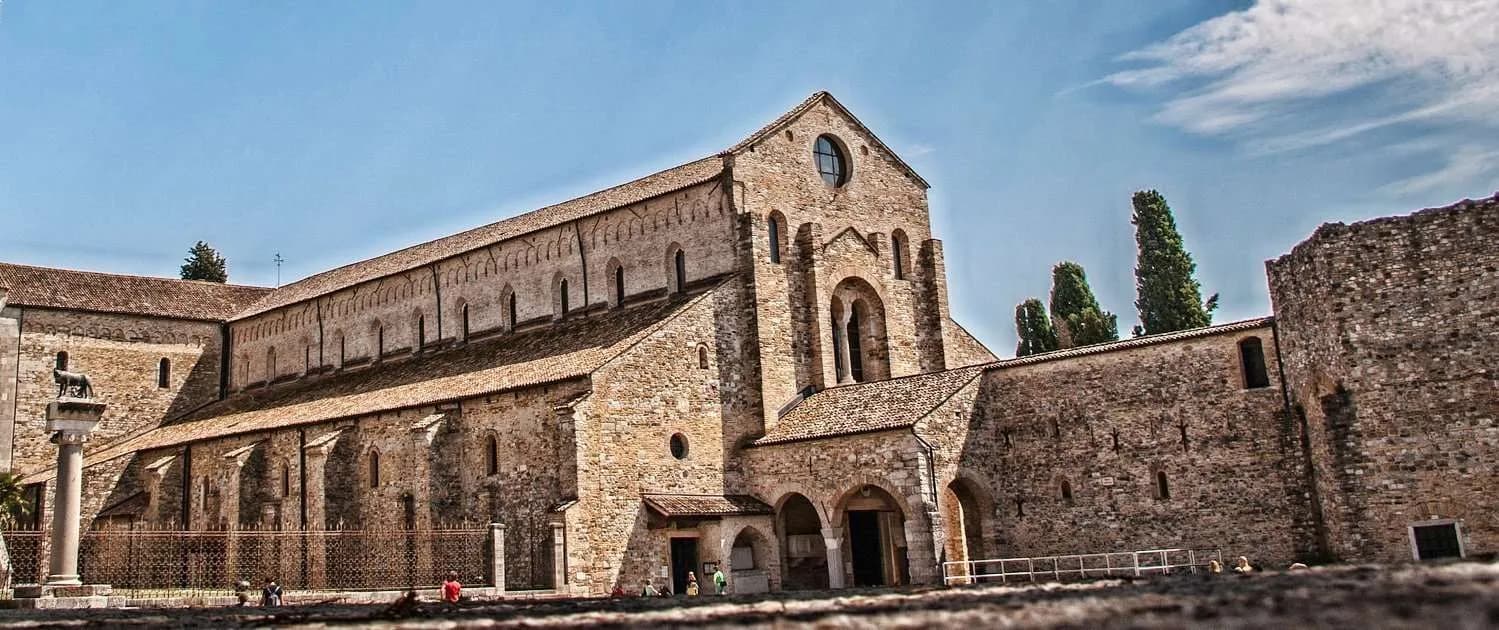
You'll find the first marker in front of the magnificent Basilica Patriarcale of Santa Maria Assunta, which houses one of the world's finest floor mosaics, dating to the 4th century CE.
With its first waymark, Aquileia offers the perfect beginning to a journey rooted in history and nature. The Via Postumia winds through places of profound Roman and medieval significance.
Like Aquileia, many Via Postumia cities boast Roman origins, evidenced by extraordinary archaeological treasures. Consider Concordia Sagittaria, Oderzo (ancient Opitergium), and Treviso. Other towns belong to more recent history: Palmanova, for instance, with its distinctive star-shaped layout, dates to the 16th century; Aiello del Friuli, also known as the "town of sundials", preserves the highest concentration of solar clocks—seventy in total—beautifully maintained.
Between Treviso and Vicenza, the Via Postumia passes through Castelfranco Veneto and Cittadella, medieval hamlets defined by their perfectly preserved encircling walls.
Route
The plains dominate, alongside country roads, trails, and secondary roads. The Ogliastra Cycle Route, built on a former military railway, is particularly scenic.
The plains are the undisputed star of this opening section of the Via Postumia, from Aquileia to Vicenza.
The walking presents no particular challenges: elevation gain is virtually non-existent, and the terrain, mostly country roads, trails, and minor roads, is accessible to all abilities.
Asphalt sections do exist, but the route consistently prioritises quieter paths, even if adding a few extra metres.
Don't miss the lovely Ogliastra Cycle Route, which takes you out of Treviso and represents a successful conversion of a disused military railway into public use.
Landscapes
This territory is notably characterized by abundant rivers and wetland zones.
Waters called "Risorgiva" are common—a geo-morphological phenomenon resulting from underground water surfacing naturally. After filtering through permeable soil, water flows underground from the upper to lower plains until a denser layer forces it to re-emerge. The Sile River, for example, originates this way.
The Via Postumia encounters numerous watercourses along its path, some renowned: the Tagliamento River, forming the natural boundary between Friuli-Venezia Giulia and Veneto; the Piave, central to World War I history; and the Sile, your companion for nearly 40 km until Treviso. The route passes near the Marano Lagoon without touching it, and skirts the famous Venetian Lagoon for several kilometres.
Over the 110 km separating Treviso and Vicenza, landscapes remain consistent—you're surrounded by verdant cultivated fields and modern countryside towns.
What to See
Aquileia
A UNESCO World Heritage Site, it was founded in 181 BCE by the Romans, who used it as a military outpost against potential barbarian invasions. Its strategic location—near the sea and oriented toward eastern Europe—quickly made it fundamental to imperial strategy and one of the most prosperous cities of its era.
Dating to the 2nd-3rd centuries CE are the Roman forum, the civil basilica, the baths, and city walls, among others. More recent is the Baptistry from around 1000 CE and the Basilica Patriarcale, built on an ancient Christian structure from 313 CE. Here you can admire one of the world's finest floor mosaics: created in the 4th century, it was covered during basilica renovations and rediscovered in 1909 by Austrian scholars.
Today Aquileia possesses an extraordinary archaeological heritage, testament to its ancient grandeur.
Palmanova
Palmanova is truly a city unlike any other.
Share
apiediperilmondo by wayure
New articles on walks, trekking and hiking trips. Free, no spam.
Co-fondatrice, Apiediperilmondo
I've been organising walks since I discovered that walking slow is the fastest way to know a place. I take care of every logistical detail so you can focus only on the steps ahead.
Profilo e tutti gli articoli di DeborahDiscover our itineraries
in Italy.
Via degli Dei in 5 stages
Via Francigena from Lucca to Siena
Via del Sale from Varzi to Portofino
Want a tailor-made itinerary?
Plan your trip