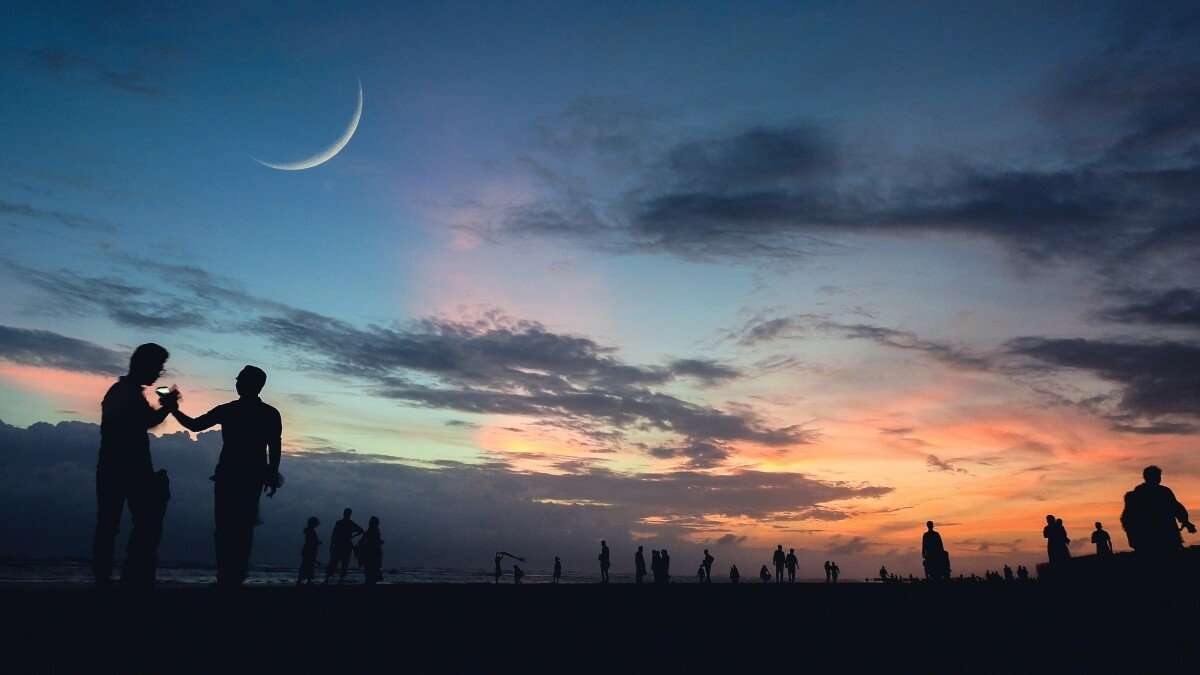
When we think of walking, we often imagine days of brilliant sunshine or, at worst, clouds gently veiling the morning sky—dawns and sunsets, sudden downpours, or snow-laden landscapes. Yet darkness rarely enters our imagination: a path under moonlight and starlit skies.
And yet, darkness exists and shapes our rhythms, giving meaning to the passage of time. Walking in its company could be a truly remarkable experience, especially for those who love nature and wish to encounter it afresh, or for those seeking a deeper way to listen to themselves.
We're accustomed to inhabiting our places—whether home or travel destinations—in daylight, when all is visible. When darkness falls, we instinctively search for a light switch to restore luminosity and make things clear. In doing so, we've lost the ability to see in darkness, to navigate by instinct alone.
Walking During a Lunar Eclipse
A special opportunity to walk in darkness while awakening these dormant abilities and exploring our inner resources and senses arrives this very month—on the night of 27-28 July. As the Moon reaches its fullness, it will pass through the very centre of Earth's shadow, creating the longest total lunar eclipse of the century, lasting 1 hour and 43 minutes.
During Friday and into Saturday, our Moon reaches apogee—its farthest point from Earth—making it appear smaller, more distant, and slower than ever. At a precise moment, the two celestial bodies align with the Sun. The night sky will blush red at first, then, around 10 p.m., turn absolute black.
The entire phenomenon, from partial eclipse to partial eclipse, will unfold over approximately 4 hours—ideal timing to plan a walk through forests or along a coastline, alone or with companions, perhaps carrying a charm or amulet.
Eclipse: Myth and Legend
Yes, because night and the Moon can provide the backdrop for a fresh walking experience while simultaneously evoking the myths, cults, and legends of ancient times—and beyond. Today, many cultures and traditions still reference celestial movements and the symbolic bond between Sun and Moon, united in an opposing yet complementary relationship: like brother and sister, husband and wife, God and Goddess.
This belief has shaped the socio-economic organisation of numerous peoples and given rise to various rituals, some still practised today. Despite its dual meaning, lunar veneration appears to precede solar worship, likely because of the Moon's visible continuous motion and changing phases, and its reputed influence on tides, vegetation, weather, menstruation, and the human psyche.
The eclipse, with its irregular passage, was historically regarded as a breach in nature's rhythm and thus associated with negative energies—or at least with the Moon's temporary inability to transmit its feminine power of nurturing and emotional sensitivity to Earth. An interpretation worth contemplating in our current times.
For those wishing to walk in darkness and listen deeply on this night, the advice is to pay attention: observe any sensations, shifts in mood, stray thoughts, physical states, or the sounds and presences among the trees or the waves, and simply notice what unfolds. To be safe, carry a charm or amulet with you—one never knows.